

How long does weed stay in your system
How Long Does THC Stay in Your System? A Quick Answer
The THC detection window — how long cannabis remains detectable in your body — varies widely depending on the type of drug test used and how often you consume cannabis.
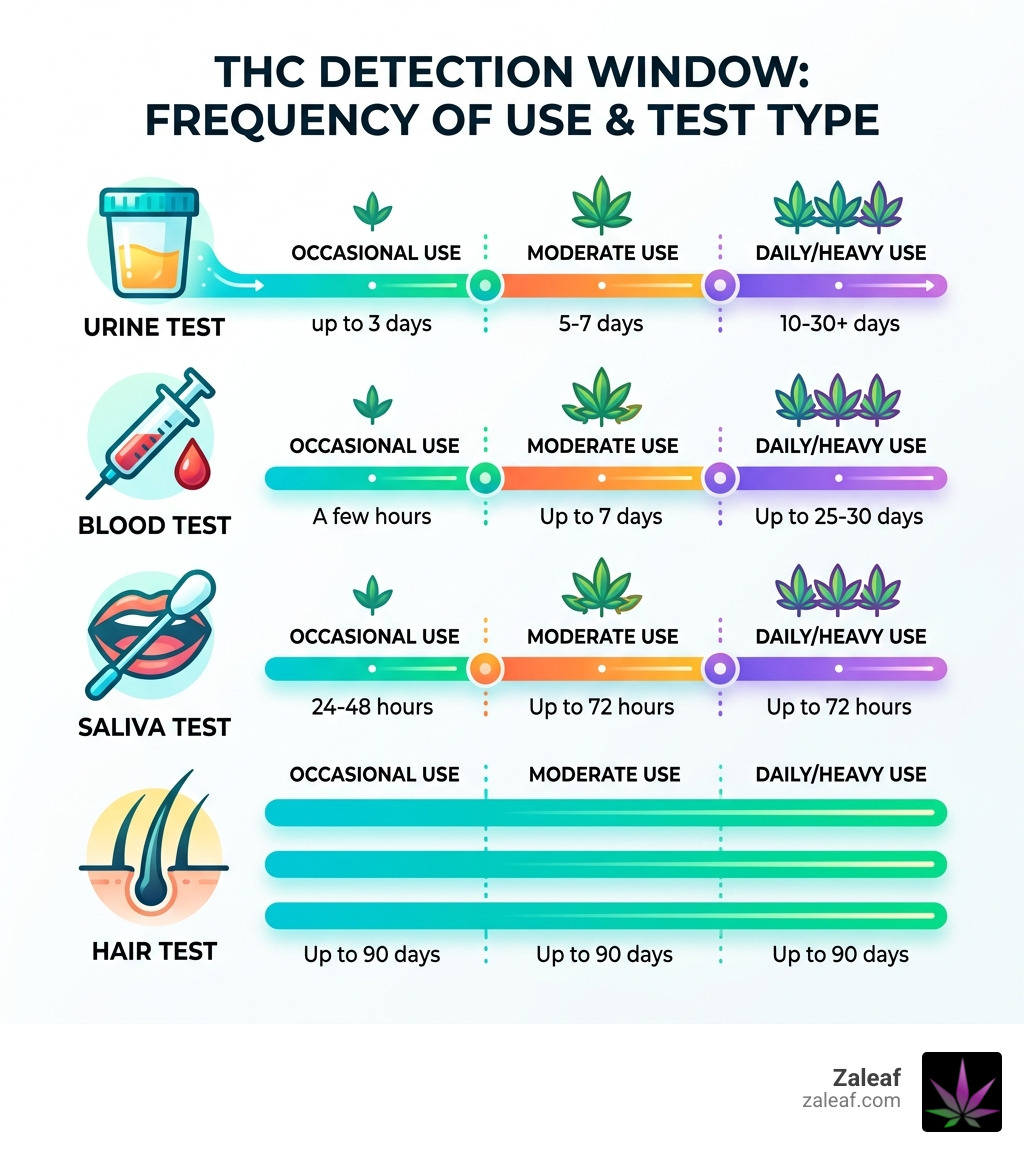
Here is a fast reference guide:
| Test Type | Occasional Use | Moderate Use | Daily/Heavy Use |
|---|---|---|---|
| Urine | Up to 3 days | 5-7 days | 10-30+ days |
| Blood | A few hours | Up to 7 days | Up to 25-30 days |
| Saliva | 24-48 hours | Up to 72 hours | Up to 72 hours |
| Hair | Up to 90 days | Up to 90 days | Up to 90 days |
A few key things to know upfront:
- Drug tests detect THC metabolites (mainly THC-COOH), not cannabis itself
- THC is fat-soluble, meaning it stores in body fat and releases slowly over time
- This is why cannabis lingers far longer in the body than alcohol does
- Your personal detection window depends on frequency of use, body composition, metabolism, and the sensitivity of the test
Unlike alcohol, which can clear the body in just a few hours, cannabis metabolites can remain detectable for weeks — or even months in heavy, long-term users.
I'm Max Shemesh, owner of Zaleaf, and with years of experience in the cannabinoid industry, understanding the THC detection window is something our team gets asked about constantly by customers who want to enjoy cannabis responsibly. In this guide, I'll walk you through everything the science actually tells us — no myths, no guesswork.
THC detection window helpful reading:
- how long does it take for thc to leave body
- how long does 0.3 thc stay in your system
- how long does thc vape stay in your system
Understanding the THC Detection Window: How the Body Processes Cannabis
To understand why a drug test might catch you weeks after your last session, we have to look at how your body handles cannabinoids. When we consume THC—whether by smoking, vaping, or eating a gummy—it doesn't just vanish once the "high" wears off.

THC is lipophilic, which is a fancy scientific way of saying it loves fat. Once it enters your bloodstream, it quickly distributes to various organs and tissues. Because it is fat-soluble, it hitches a ride into your fat cells (adipose tissue), where it can set up camp for quite a while. This is the primary reason the THC detection window is so much longer than that of water-soluble substances like alcohol or cocaine.
The Metabolism Journey
Once in your system, the liver goes to work. It breaks down the psychoactive Delta-9 THC into metabolites. The first stop is often 11-OH-THC, which is actually more potent and psychoactive than the original THC. Eventually, the liver converts this into THC-COOH, an inactive metabolite.
Drug tests aren't usually looking for the "active" THC that makes you feel high; they are looking for THC-COOH because it stays in the body much longer. We excrete these metabolites in two main ways:
- Feces: Approximately 65% of cannabis leaves the body this way.
- Urine: About 20% is excreted through your pee.
The remaining percentage stays stored in those fat cells, slowly leaking back into the bloodstream over days or weeks. For more details on this biological "slow burn," check out our guide on how long it takes for THC to leave the body.
Detection Timelines by Test Type: Urine, Blood, Saliva, and Hair
Not all drug tests are created equal. Some look for very recent use, while others act like a "history book" of your cannabis consumption over the last few months. Most screenings use an immunoassay (a quick, antibody-based test) as a first step. If that comes back positive, the lab usually performs a more accurate GC/MS (Gas Chromatography-Mass Spectrometry) test to confirm the result.
The "cutoff level" is also vital. This is the concentration of metabolites required to trigger a positive result. For urine, the standard industry cutoff is 50 ng/mL, though some strict programs (like the military or certain court systems) use a 20 ng/mL threshold, which significantly extends the THC detection window.
| Test Type | Detection Window | Best For |
|---|---|---|
| Urine | 3 to 30+ days | Standard workplace screening |
| Blood | 12 hours to 7 days | Accident investigation / Recent use |
| Saliva | 24 to 72 hours | Roadside testing / Recent use |
| Hair | Up to 90 days | Long-term history |
| Sweat | 7 to 14 days | Continuous monitoring |
For a deeper dive into the clinical specifics, you can reference the Marijuana - Mayo Clinic Laboratories data.
Urine Testing and the Standard THC Detection Window
Urine testing is the most common method because it's cheap and has a reliable window. If you are a first-time user, you might be clear in as little as 3 days. However, if you're a chronic heavy user (using multiple times daily), that window can easily stretch to 30 days or more.
Interestingly, the type of product matters too. Concentrates like wax or dabs have much higher THC percentages than standard flower, which can lead to more metabolites being stored in your fat cells. We've broken this down further in our article about how long wax THC stays in your system.
Blood, Saliva, and Hair: Alternative THC Detection Windows
- Blood Tests: These detect "active" THC. For occasional users, the window is tiny—often just 1 to 12 hours. However, in chronic users, THC can be detected in the blood for up to 25 or 30 days because it is constantly being released from fat stores.
- Saliva Tests: Often used for roadside DUI checks, these look for THC that has remained in the mouth. Generally, the window is 24-72 hours.
- Hair Follicle Tests: This is the most "stubborn" test. THC takes about 7-10 days to even show up in your hair, but once it's there, it stays. Labs usually test the 1.5 inches of hair closest to the scalp, which represents a 90-day history.
If you're a fan of edibles, keep in mind that they are processed differently by the liver, which can slightly shift these timelines. Learn more about how long THC gummies remain detectable.
Individual Factors Influencing THC Retention and Elimination Strategies
Why can one person pass a test in five days while another takes twenty? It comes down to individual biology and lifestyle.
- Body Mass Index (BMI) and Body Fat: Since THC hides in fat, the more body fat you have, the more "storage space" there is for metabolites. This can significantly lengthen your THC detection window.
- Metabolism: Just like some people can eat pizza every day and stay thin, some people process cannabinoids faster than others.
- Frequency and Potency: A single puff of a low-THC joint is a world away from daily use of 90% THC vape pens. Frequent use causes "buildup" in the system.
- Genetics and Gender: Some studies suggest women may metabolize THC slightly differently than men due to differences in body fat distribution, and genetic variations in liver enzymes play a massive role.
For a complete breakdown of how these factors interact, see our ultimate THC system guide.
Speeding Up the Elimination of THC
We’ve all seen the "miracle" detox kits online. But do they work? The short answer is: mostly no. Most "detox" drinks work by temporarily diluting your urine and adding B vitamins and creatinine so the lab doesn't flag the sample as "diluted." They don't actually remove THC from your fat cells.
- Hydration: Drinking water is great for your health, but it doesn't "wash" THC out of your fat. It only dilutes your urine temporarily.
- Exercise: In the long term, burning fat helps remove stored THC. However, do not exercise right before a drug test. A 2013 study showed that exercise can actually cause a temporary spike in blood THC levels as the fat cells release the stored cannabinoids.
- Time and Abstinence: These are the only 100% reliable methods. Your body needs time to naturally metabolize and excrete the metabolites.
If you're looking for strategies to navigate this, check out our guide on The Great THC Escape.
Frequently Asked Questions about THC Detection
How does usage frequency affect the THC detection window?
This is the single biggest factor.
- First-time use: Detectable for about 3 days.
- Moderate use (3-4 times a week): 5-7 days.
- Daily use: 10-15 days.
- Chronic heavy use (multiple times daily): 30 days or longer.
In one study, the half-life of THC was just 1.3 days for infrequent users, but between 5 and 13 days for frequent users. This means it takes much longer for the concentration to drop by half when you use it regularly.
Can CBD or Delta-8 products cause a failed drug test?
Yes, they can.
- CBD: If you use "Full-Spectrum" CBD, it contains up to 0.3% THC. While that sounds small, heavy use can cause enough THC-COOH to build up to trigger a positive result.
- Delta-8: Most drug tests cannot distinguish between Delta-9 (traditional weed) and Delta-8. Because Delta-8 breaks down into the same THC-COOH metabolite, it will almost certainly cause a "fail" on a standard screen.
For more on how different products impact your results, see the Scientific Research in Hospital Solutions guide.
Is there a reliable way to pass a drug test quickly?
The only "quick" way is to not have THC in your system. Dilution (drinking massive amounts of water) can work but is risky, as modern labs check for creatinine levels and specific gravity to ensure the sample isn't tampered with. Myths like drinking vinegar, bleach (please don't do this!), or using niacin are ineffective and can be dangerous.
Conclusion
Navigating the THC detection window can be tricky because our bodies are all unique. Whether you’re a light user or a daily connoisseur, the science shows that factors like body fat, metabolism, and the type of test used are the real deciders of how long weed stays in your system.
At Zaleaf, we believe in transparency and education. That’s why all our 100% legal cannabis products undergo rigorous 3rd-party testing—so you know exactly what you’re putting into your body. We offer mood-specific effects with fast, discrete shipping and no medical card required.
If you're curious about how modern consumption methods like vapes compare to traditional flower in terms of detection, check out our deep dive: From Puff To Test: Understanding How Long THC Vape Pens Stay In Your System.
Stay safe, stay informed, and enjoy responsibly!