

Weed Detection Windows and How Long Until You Are Clean
How Long Does THC Stay in Your System? (Quick Answer)
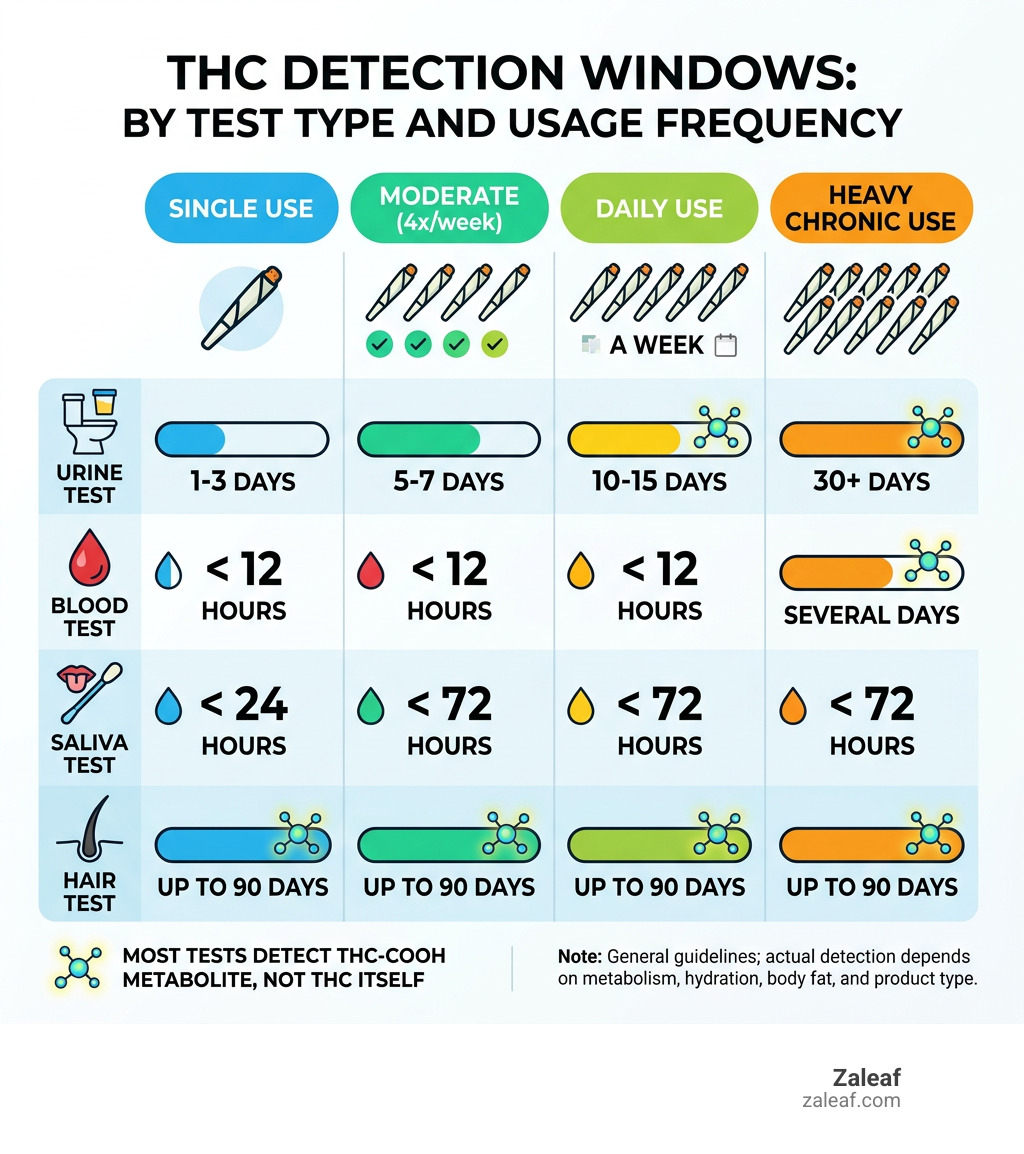
How long does it take for THC to leave body depends mostly on how often you use cannabis — here's a fast breakdown:
| Usage Pattern | Urine Detection | Blood | Saliva | Hair |
|---|---|---|---|---|
| Single use | Up to 3 days | Up to 12 hours | Up to 24 hours | Up to 90 days |
| Moderate (4x/week) | 5–7 days | Up to 12 hours | Up to 72 hours | Up to 90 days |
| Daily use | 10–15 days | Up to 12 hours | Up to 72 hours | Up to 90 days |
| Heavy chronic use | 30+ days | Several days | Up to 72 hours | Up to 90 days |
These are general windows. Your actual clearance time depends on body fat, metabolism, hydration, and the type of product you used.
THC is fat-soluble, which means it doesn't flush out quickly like alcohol. It binds to fat cells and releases slowly back into your bloodstream over time. That's why a single session might clear in 3 days, while daily use can leave traces detectable for over a month.
Most drug tests don't look for THC itself — they detect THC-COOH, a metabolite your liver produces when it breaks down THC. This metabolite lingers long after the high is gone.
Through years of working directly in the cannabinoid industry, it's clear how often people are caught off guard by how long does it take for THC to leave body — especially when switching products or usage patterns. In this guide, we'll walk you through exactly what the science says, so you can make informed decisions.
Common how long does it take for thc to leave body vocab:
- How long does 0.3 THC stay in your system?
- How long does THC drink stay in your system?
- How long does THC vape stay in your system?
Understanding THC and How Your Body Processes It
To understand how long does it take for thc to leave body, we first have to look at what happens the moment you take a puff or eat a gummy. Marijuana is classed as a psychoactive drug, and its primary "star of the show" is Delta-9 tetrahydrocannabinol (THC).
When you consume THC, it doesn't just float around in your blood forever. It is incredibly "lipophilic," which is a fancy science word for "fat-loving." This means THC quickly leaves your bloodstream and hides out in your body's fat tissues (adipose tissue). This is why you can feel sober a few hours later, but still have detectable levels in your system.
The Role of the Liver and Metabolites
Your liver is the main processing plant. It breaks down Delta-9 THC into several metabolites. The two most important ones for drug testing are:
- 11-hydroxy-THC: This is what makes you feel high, especially with edibles.
- THC-COOH (Carboxy-THC): This is the non-psychoactive metabolite that stays in your fat cells and is eventually released. This is what almost all drug tests are looking for.
How THC Leaves the Body
We often think we can just "pee it all out" in a day, but the body has a specific exit strategy. Research shows that about 65% of cannabis is excreted through feces, while only about 20% leaves through urine. The rest is stored as metabolites in your fat, waiting for its turn to be processed. Because it is stored in fat, your metabolic rate and body fat percentage play a massive role in the timeline.
How Long Does It Take for THC to Leave Body?
There is no "one size fits all" answer to how long does it take for thc to leave body. It’s like asking how long it takes to finish a marathon—it depends on how fast you run and how much training you’ve done.
The elimination half-life of THC varies significantly. For infrequent users, the half-life is roughly 1.3 days. For frequent users, that half-life can stretch to 5–13 days. This means it takes much longer for a heavy user's body to reduce the THC concentration by half compared to someone who only smokes once a month.
Several factors dictate this timeline:
- Frequency of use: The more often you use, the more THC builds up in your fat stores.
- Dosage and Potency: Higher concentrations (like dabs or high-potency carts) take longer to clear.
- Metabolic Rate: People with higher metabolisms process and excrete metabolites faster.
Urine testing remains the most common method for employers and labs because it has a wider detection window than blood or saliva.
How Long Does It Take for THC to Leave Body After a Single Use?
If you just had one joint at a party and haven't touched weed in months, don't panic. For a single use, THC is typically detectable in urine for up to 3 days. Your body treats this as an "acute consumption" event and clears it relatively quickly because there is no "backlog" of THC stored in your fat cells.
In terms of recent cannabis use, blood tests will usually only show a positive result for 2 to 12 hours after a single session.
How Long Does It Take for THC to Leave Body for Chronic Users?
This is where things get tricky. If you are a daily or heavy chronic user, you are likely looking at a 30 days threshold—and sometimes even longer.
In heavy users, THC metabolites build up in the adipose (fat) tissue. Even after you stop using, your body continues to release these stored metabolites back into the blood and then into the urine as your fat cells naturally break down. This "residual release" can cause intermittent positive tests even weeks after your last use. In extreme cases of heavy, long-term use, some individuals have tested positive for more than 60 to 90 days.
Detection Windows by Drug Test Type
Different tests have different "look-back" periods. If you're wondering how long does it take for thc to leave body, you have to know which test you're taking.
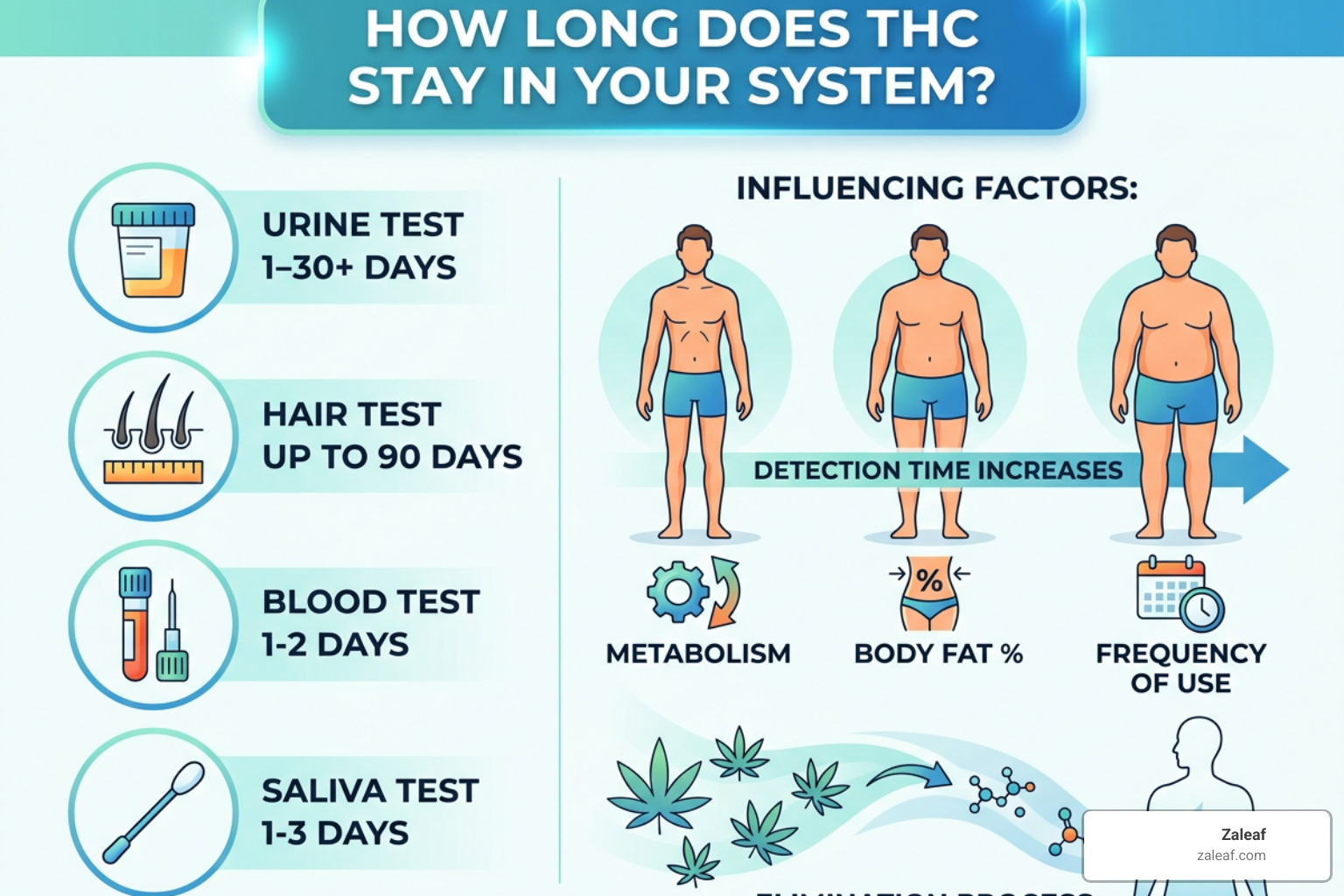
Urine Testing Windows
According to a 2017 review, here are the standard windows for urine:
- Single use (one joint): 3 days
- Moderate use (4 times per week): 5–7 days
- Frequent use (daily): 10–15 days
- Chronic heavy use (multiple times daily): 30+ days
Blood and Saliva Detection
Blood and saliva tests are generally used to detect "recent" use, often for roadside testing or post-accident investigations.
- Blood: THC is typically detectable for 2–12 hours. However, in very heavy users, it has been detected for several days as it leaches out of fat stores.
- Saliva: A 2020 review found that THC can be detected in the oral fluid of frequent smokers for up to 72 hours. For occasional users, this window is usually closer to 24 hours.
Hair Follicle Tests
Hair tests are the "history books" of drug testing. They can detect use for up to 90 days. When you consume THC, it reaches the hair follicles via small blood vessels. As the hair grows (at a rate of about 0.5 inches per month), the THC is locked into the hair shaft. A standard 1.5-inch hair sample provides a 90-day window of your history. Interestingly, hair tests are often less sensitive for very light, one-time users but are highly effective for identifying chronic patterns.
Factors That Influence THC Retention
Why does one person clear THC in 5 days while another takes 20? It comes down to biology and lifestyle.
- Body Mass Index (BMI) and Body Fat: Since THC is fat-soluble, the more body fat you have, the more "storage space" there is for THC metabolites. People with higher body fat percentages generally retain THC longer.
- Hydration Levels: While drinking water won't "flush" THC out of your fat cells, being dehydrated can make your urine more concentrated, which might lead to a higher concentration of metabolites on a test.
- Physical Activity: Exercise helps burn fat, which releases stored THC. However, be careful—exercising right before a drug test might actually cause a temporary "spike" in detectable THC levels in your blood and urine as those fat cells break down.
- Age and Metabolism: As we age, our metabolism often slows down, and our liver function may become less efficient, potentially lengthening the time it takes to clear metabolites.
- Consumption Method: How you get the THC into your system matters. Edibles have to pass through the digestive system and liver, often leading to a higher production of metabolites. Vaping or smoking enters the blood via the lungs almost instantly. If you're curious about specifics, you can read more about how long thc vape pens stay in your system.
Frequently Asked Questions about THC Detection
Can Delta-8 or THCa cause a positive drug test?
Yes, absolutely. This is a huge point of confusion.
- Delta-8 THC: Most standard drug tests look for the THC-COOH metabolite. Delta-8 is chemically very similar to Delta-9, and its metabolites often cause "cross-reactivity" on a standard screen, leading to a positive result.
- THCa: THCa is the non-psychoactive precursor found in raw cannabis. However, a 2018 study suggests that even if you aren't "heating" it (which converts it to Delta-9), it can still be detected in the blood and eventually show up as metabolites. Most THCa products also contain trace amounts of Delta-9, which can trigger a positive.
Does secondhand smoke show up on a test?
It is highly unlikely, but not impossible in extreme scenarios. You would have to be trapped in a tiny, unventilated closet with several heavy smokers for hours to potentially absorb enough THC to trigger a positive result. Under normal social conditions, secondhand smoke will not cause you to fail a drug test.
Can CBD products lead to a failed drug screen?
Yes, and here is why. Many CBD products are "Full Spectrum," meaning they contain up to 0.3% THC. While this isn't enough to get you high, regular use can cause that tiny amount of THC to build up in your fat cells over time. Additionally, the CBD industry is not always perfectly regulated; some products may contain more THC than the label claims. To learn more about the complexities of different cannabinoids, check out The ABCs of CBD.
Conclusion
At the end of the day, how long does it take for thc to leave body is a process of natural elimination. There are no "magic pills" or detox drinks that can safely and instantly scrub THC from your fat cells. The only 100% effective way to test clean is through abstinence and giving your body the time it needs to metabolize the stored compounds.
A healthy lifestyle—staying hydrated, eating a balanced diet, and regular exercise—can support your body's natural detoxification pathways (the liver and kidneys). However, don't rely on "quick fixes" found on the internet; many of these can lead to electrolyte imbalances or diluted samples that labs will flag as suspicious.
We believe in transparency and the power of informed consumption. Our products are 100% legal and undergo rigorous 3rd party testing to ensure you know exactly what you are putting into your system. We specialize in enhancing cannabinoid and terpene profiles to help you achieve specific moods—all with discrete packaging and no medical card required.
Whether you're exploring vapes or interested in how long different methods last, we've got the resources to help. For more details on specific products, see our guide on how long thc vape pens stay in your system. Stay safe, stay informed, and enjoy the journey responsibly!