

THCV for Focus: The Ultimate Guide to Productive Buzzing

Why THCV for Focus Is the Cannabinoid Worth Knowing About

THCV for focus is gaining real attention — and for good reason.
If you want the quick answer:
How THCV supports focus:
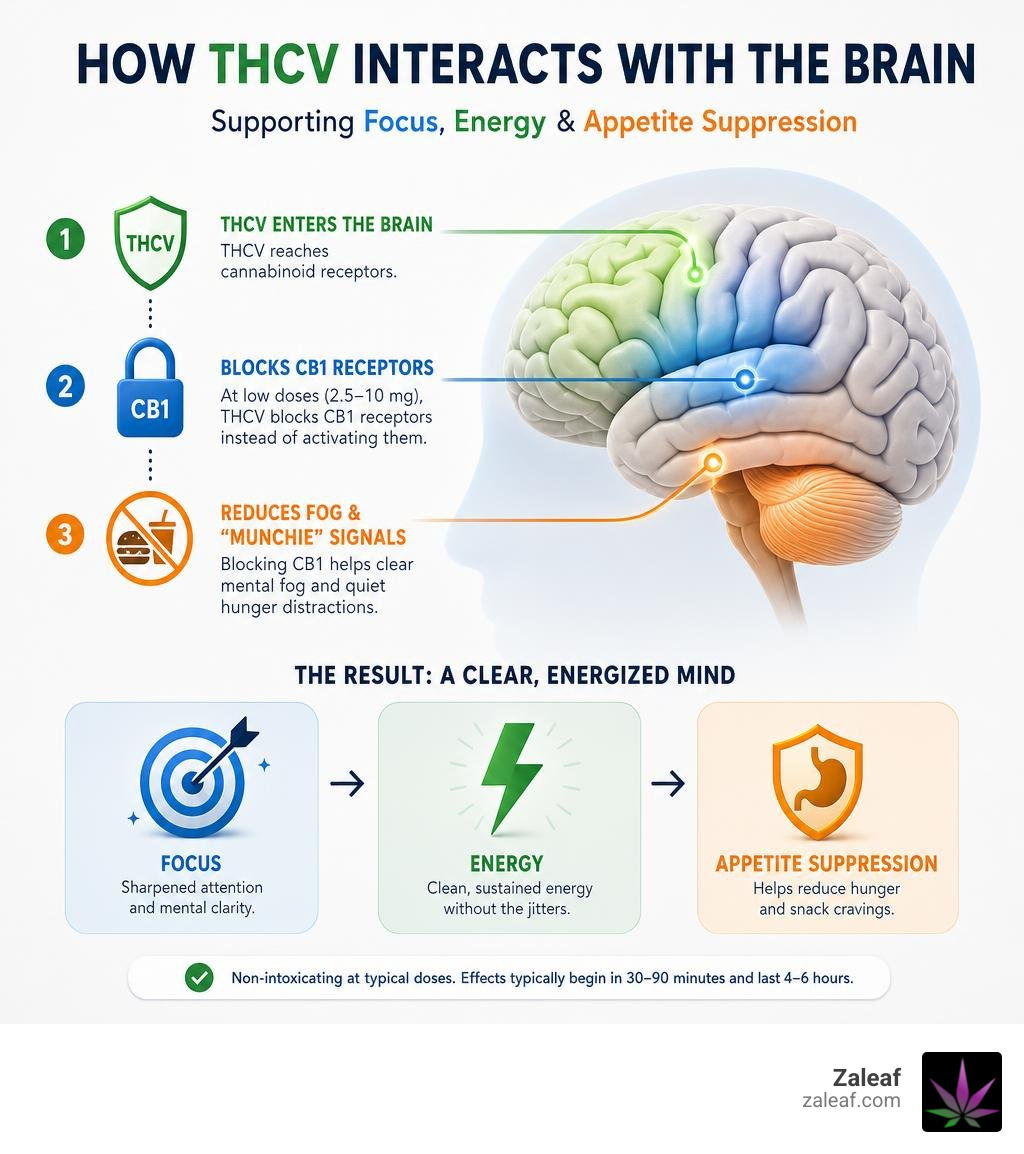
- At low doses (2.5–10 mg), THCV blocks CB1 receptors in the brain instead of activating them
- This blocking effect reduces mental fog and dampens the "munchie" signals that distract your attention
- The result is a clean, energized feeling — not a high — that most users describe as sharp and functional
- Effects typically kick in within 30–90 minutes and last 4–6 hours
- It is non-intoxicating at typical doses (intoxication only reported at 100–200 mg, versus ~5 mg for THC)
Most people reaching for a focus aid are stuck choosing between coffee jitters, prescription stimulants, or supplements that don't do much. THCV sits in a different lane entirely. It's a minor cannabinoid found in trace amounts in certain cannabis strains — and unlike THC, it blocks the receptors associated with sedation, appetite, and mental fog rather than activating them. Early clinical research and a growing wave of user reports suggest it may be one of the most interesting natural tools for daytime cognitive performance available right now.
I'm Max Shemesh, CEO of Zaleaf, and I've spent years working directly in the cannabinoid industry — sourcing, formulating, and helping thousands of customers find the right products for their goals, including THCV for focus. In the guide below, I'll break down exactly how THCV works, how to dose it, and how to choose the right product format for your needs.
Discover more about THCV for focus:
What is THCV and How Does It Differ From THC?
To understand how tetrahydrocannabivarin (THCV) works, we have to look at the cannabis plant's chemical genealogy. Often referred to as a "minor cannabinoid" because it appears in much smaller quantities than CBD or Delta-9 THC, THCV actually has a completely unique origin story.
Most common cannabinoids—like THC and CBD—evolve from the precursor acid CBGA. THCV, however, starts its life as CBGVA (cannabigerovarinic acid). As the plant matures and is exposed to heat and light, CBGVA converts into THCVA, which then undergoes decarboxylation to become active THCV.
Because of this unique lineage, THCV interacts with our endocannabinoid system (ECS) in a way that is almost the exact opposite of traditional THC. While THC binds directly to CB1 receptors to trigger the classic, relaxed "high" and the inevitable snack-cabinet raid, THCV acts as a gatekeeper. By understanding these subtle interactions, we can begin to see why THCV is making waves as a functional, daytime compound. To learn more about how these family lines connect, check out our guide on Beyond the Buzz: A Comprehensive Look at THC and Its Cousins.
The Molecular Difference: Propyl vs Pentyl Side Chains
The difference between feeling deeply relaxed on your couch and feeling laser-focused at your desk comes down to a tiny structural variation.
At the molecular level, THC possesses a pentyl (five-carbon) side chain. This five-carbon structure allows it to bind perfectly as an agonist to CB1 receptors in the brain, activating them fully. THCV, on the other hand, has a propyl (three-carbon) side chain.
This shorter carbon chain completely changes how the molecule behaves. Instead of activating the CB1 receptor, low doses of THCV act as a CB1 receptor antagonist. It essentially parks in the receptor slot, blocking other compounds (including our body's internal endocannabinoids) from turning it on. This blocking action prevents the mental fog, slow reaction times, and heavy physical sensations typically associated with cannabis. For a deeper look at how cannabinoid precursors change structure, read our breakdown of What is THCA.
Is THCV Intoxicating?
One of the most common questions we hear is: "Will THCV get me high?" The answer is highly dependent on your dose, showcasing what pharmacologists call a biphasic nature.
At low to moderate doses (typically anywhere from 2 mg up to 10 mg), THCV is completely non-intoxicating. It acts as a CB1 antagonist, meaning it keeps your head clear, your thoughts sharp, and your energy levels elevated without any mind-altering effects.
However, if you consume very high doses, THCV undergoes a molecular shift. At high concentrations, it flips from a CB1 antagonist to a partial CB1 agonist. In this range, it can produce a mild, clear-headed euphoria.
But how high is "high"?
- Standard Delta-9 THC can produce noticeable psychoactive effects starting at just 5 mg.
- THCV, by contrast, only begins to produce reported feelings of intoxication in test subjects at doses between 100 mg and 200 mg.
This massive threshold difference means that when you use commercial THCV products designed for productivity, you are nowhere near the intoxicating limit. You get the mental benefits without the cognitive compromise. For more details on user experiences and early trials, explore THCV: Does This Minor Cannabinoid Work for Focus and Energy?.
How to Use THCV for Focus and Mental Clarity

Using THCV for focus is all about timing and intention. Unlike evening-use cannabinoids designed to help you wind down, THCV is built for daytime productivity, deep work, and supporting executive function. Many users report that a morning or mid-afternoon dose provides a smooth wave of sustained attention, helping them power through complex tasks without the sudden crash associated with energy drinks or caffeine.
To get the most out of your routine, it helps to treat cannabinoids as part of a structured wellness regimen. You can read more about integrating these plants into your daily life in our Cannabis for Wellness: Complete Guide.
Finding Your THCV for Focus Dosage Sweet Spot
When it comes to cognitive enhancement, less is almost always more. Microdosing is the preferred strategy for anyone using THCV to stay sharp.
For clean, sub-psychoactive focus and energy, we recommend a starting dose of 2.5 mg to 5 mg.
At this microdose level, THCV remains firmly in its CB1 antagonist zone. In a notable cognitive study, participants using a 5 mg sublingual strip performed 15% better on Stroop Effect tests—which measure selective attention and cognitive flexibility—compared to those given a placebo.
If you are new to THCV, start with 2.5 mg in the morning. Give your body 3 to 5 days to adapt. If you feel you need a bit more physical energy or mental drive, you can slowly increase your dose up to 10 mg. Keeping your dose under this threshold ensures you stay in the productive, non-foggy sweet spot. For a deeper dive into the microdosing movement, check out THCV Microdosing: 2026’s Natural Focus Revolution.
Best Delivery Methods: Gummies, Vapes, and Tinctures
How you take THCV determines how fast it starts working and how long the productivity window lasts. Here is how the most popular delivery methods compare:
- Sublingual Strips & Tinctures: Held under the tongue, these bypass the digestive system for rapid absorption. You will typically feel the effects within 15 to 30 minutes, making them perfect for unexpected, high-demand work sessions.
- Gummies & Edibles: Because they must pass through your liver, edibles have a slower onset time of 30 to 90 minutes. However, they offer the longest duration, providing a steady release of focus that lasts 4 to 6 hours.
- Vapes: Inhalation offers almost instant onset (under 5 minutes), but the effects taper off much faster (usually within 1 to 2 hours). This makes vapes ideal for quick bursts of daytime creativity. To learn more about hardware and oil options, see The Ultimate Guide to Cannabis Vape Carts: From THC to CBD.
The Science of THCV: Appetite, Metabolism, and Cognitive Performance

Beyond simple focus, THCV is one of the most thoroughly researched minor cannabinoids for metabolic and physical health. Because the endocannabinoid system plays a massive role in regulating our metabolic rate, insulin sensitivity, and satiety signals, THCV's unique blocking mechanism has caught the attention of clinical researchers worldwide.
For instance, a landmark double-blind, randomized controlled trial published in Diabetes Care studied type 2 diabetes patients over a 13-week period. The researchers found that patients given THCV showed significant improvements in fasting plasma glucose and increased levels of adiponectin (a hormone that regulates glucose levels and fatty acid breakdown) compared to the placebo group. To understand how these full-spectrum interactions support the body as a whole, explore The Full Spectrum Story: What You Need to Know About Hemp's Powerhouse Compounds.
The "Diet Weed" Effect: Appetite Suppression and Weight Management
In popular culture, THCV has earned the nickname "diet weed." While we always advise treating hype with a healthy dose of skepticism, the science behind this effect is incredibly solid.
Traditional THC triggers the "munchies" by activating CB1 receptors in the hypothalamus—the brain's appetite control center—and stimulating the release of hunger hormones like ghrelin. Because THCV blocks these same CB1 receptors, it prevents these hunger signals from getting through, effectively reducing "food noise" and helping users manage cravings.
The real-world data is highly promising:
- In a study, obese adults given a combination of THCV and CBD showed statistically significant weight loss and decreases in abdominal girth.
- A pilot study using fMRI brain scans showed that low doses of THCV reduced neural activity in appetite-relevant brain regions when subjects were presented with food cues, helping them feel satisfied faster.
How THCV for Focus Compares to CBD, CBG, and THCP
Every cannabinoid has its own "specialty." To help you choose the right compound for your specific daily goals, let's look at how THCV stacks up against other popular hemp derivatives.
- CBD (Cannabidiol): Excellent for overall nervous system calm and physical relaxation, but does not actively boost energy or drive. Learn more about its benefits in Unlocking Wellness: The Top CBD Benefits Explained.
- CBG (Cannabigerol): Known as the "cognitive restorer," CBG is fantastic for mental clarity and physical comfort, but lacks the specific energizing, dopamine-modulating kick of THCV.
- THCP (Tetrahydrocannabiphorol): An extremely potent cannabinoid with a long carbon chain, used primarily for intense, long-lasting relaxation and heavy physical effects. It is not suitable for daytime productivity.
- THCV: The ultimate "functional specialist," offering clean energy, focus, and metabolic support without sedation or heavy psychoactivity.
| Cannabinoid | Primary Effect | Intoxicating? | Best Use Case |
|---|---|---|---|
| THCV | Energy, Focus, Appetite Control | No (at low doses) | Deep work, fasting, morning productivity |
| CBD | Stress relief, Physical calm | No | Evening winding down, general wellness |
| CBG | Mental clarity, Gut health | No | Mild focus, soothing physical discomfort |
| THCP | Strong euphoria, Deep relaxation | Yes (extremely potent) | Nighttime use, intense physical relief |
Frequently Asked Questions About THCV
As interest in alternative cannabinoids grows, keeping our community safe and informed is our top priority. Here are the facts regarding the safety, legality, and practical use of THCV.
Is THCV legal under the 2018 Farm Bill?
Yes, federally. Under the 2018 Farm Bill, all hemp-derived cannabinoids containing less than 0.3% Delta-9 THC by dry weight are classified as legal industrial hemp. Because our THCV is extracted entirely from compliant hemp plants, it is federally legal to produce, ship, and enjoy.
However, state-level regulations can vary. Currently, a handful of states have restricted or banned hemp-derived cannabinoids, including:
- Alaska
- Arizona
- Arkansas
- Delaware
- Idaho
- Iowa
- Mississippi
- Montana
- Nebraska
We always recommend checking your local and state laws before purchasing.
What are the potential side effects of THCV?
At standard focus-enhancing doses (2.5 mg to 10 mg), side effects are rare and mild. Because THCV does not overstimulate the central nervous system like caffeine, it won't give you the "jitters." However, some users may experience:
- Dry mouth (a common trait of all cannabinoids)
- Mild fatigue (usually only if taken in very high doses as the effects wear off)
- Mild dehydration
- Sleep interference (if taken within 6 hours of bedtime due to its energizing nature)
Staying hydrated and timing your doses for the morning or early afternoon easily mitigates these effects.
Will THCV show up on a drug test?
Yes, it is highly likely. Standard drug screenings (like urine tests) do not look for THCV specifically. Instead, they use antibodies designed to detect THC-COOH, a common metabolite produced when the body processes any THC-like compound.
Because THCV shares a similar chemical structure to Delta-9 THC, its metabolites can trigger a "false positive" due to cross-reactivity on standard immunoassay tests. If you are subject to workplace or legal drug testing, we recommend treating THCV with the same caution you would use with any other THC product.
Conclusion
Whether you are looking to replace your third cup of morning coffee, manage distracting daily food cravings, or unlock a state of calm, sustained deep work, THCV for focus offers a scientifically backed, plant-based alternative. By working in harmony with your body’s endocannabinoid system rather than overriding it, THCV provides the mental clarity you need to stay productive without the crash, jitters, or fog of traditional stimulants.
At Zaleaf, we specialize in crafting premium, 100% legal cannabis products designed for mood-specific effects. We focus on optimizing cannabinoid and terpene profiles so you get exactly the experience you are looking for—whether that's energy, focus, or relaxation. Every single batch we produce undergoes rigorous third-party lab testing to ensure absolute purity and potency. Plus, we offer fast shipping and discrete packaging straight to your door, with no medical card or ID required.
If you are curious about how cannabinoids fit into a modern wellness routine, dive into our discussion on The Great Debate: Is Cannabis a Supplement.
Ready to experience clean, plant-powered productivity for yourself? Explore Zaleaf's full range of legal cannabinoid products and find your perfect daytime formula today!