

Know Your Rights Before Trying Delta 8 and Delta 9 Gummies
Is Delta 9 Legal in Gummies?
As of November 2026, the old 0.3% Delta 9 dry-weight rule is not enough to make a gummy legal hemp. A federal change that took effect November 12 excludes finished products with more than 0.4 mg of total THC per container. State rules can be stricter. Before buying Delta 8 or Delta 9 gummies, check your state's law and a batch-specific lab report. And if you face workplace testing, know that hemp-derived Delta 9 can still cause a positive THC result.
I'm Max Shemesh, owner and CEO of Zaleaf. Building a third-party-tested cannabinoid brand has shown me why understanding legal Delta 9 rules matters before trying a gummy.
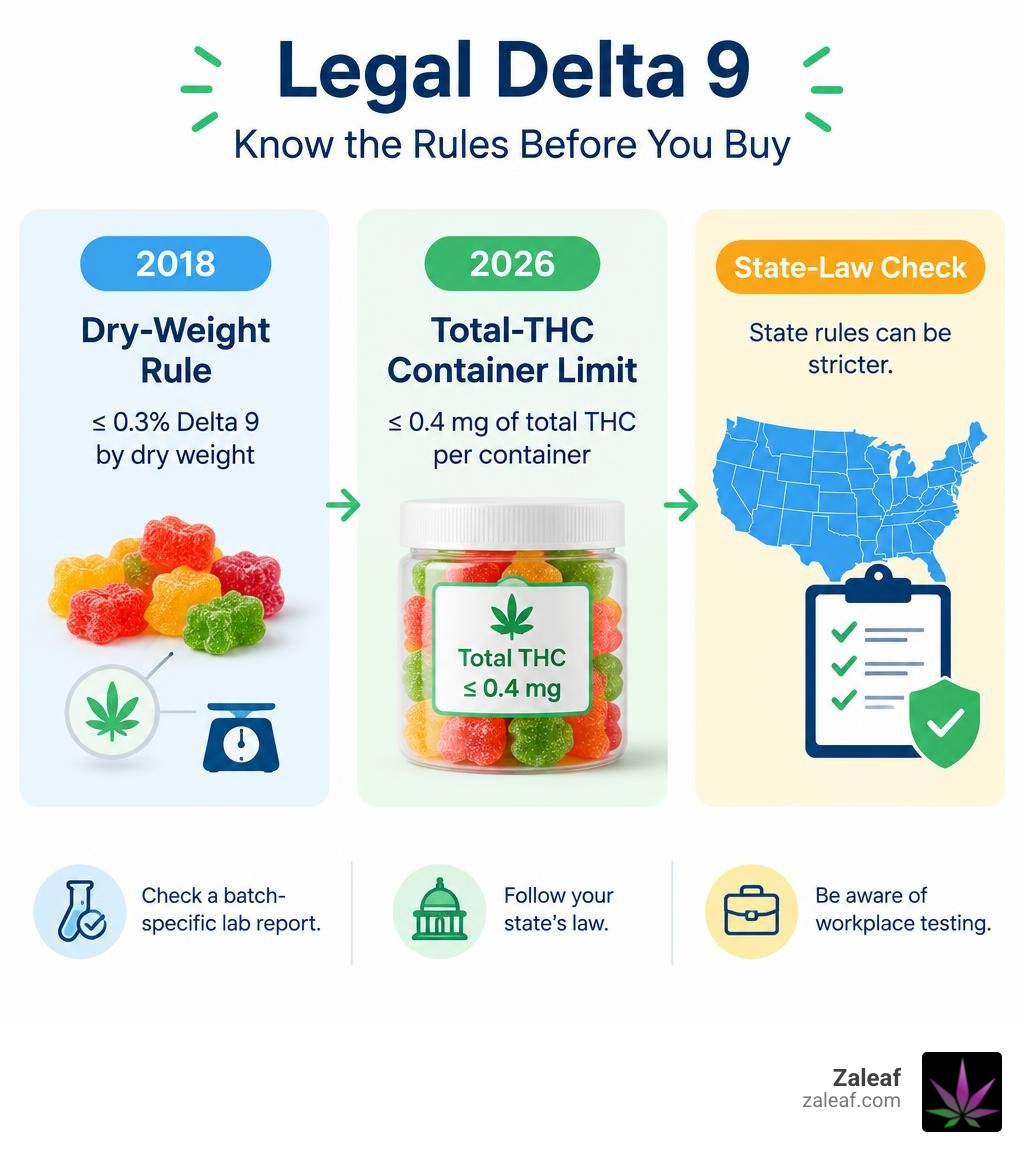
Legal Delta 9 terms explained:
How the 2018 Farm Bill Makes Legal Delta 9 Possible
Understanding why hemp-derived cannabinoids appeared on store shelves nationwide starts with the Agriculture Improvement Act of 2018. Under statutory hemp definitions established in 7 U.S.C. § 1639o, Congress formally removed industrial hemp from the Controlled Substances Act. The law defined hemp as any part of the Cannabis sativa L. plant, including all derivatives, extracts, cannabinoids, and isomers, containing a Delta-9 tetrahydrocannabinol concentration of not more than 0.3 percent on a dry weight basis.
By defining legality strictly through a percentage threshold rather than a milligram limit per serving, the legislation created an avenue for federally compliant hemp products to be sold and transported across state lines. To see how these statutory limits translate to infused products, exploring hemp edible legal limits clarifies how manufacturers navigate these concentration standards.
The 0.3% Dry Weight Rule and the Edibles Loophole
The mechanics behind the 0.3% threshold depend entirely on product mass. Because the law measures Delta 9 concentration relative to total dry weight, heavier edible products like gummies, cookies, and beverages can legally contain significant amounts of active THC while remaining well below the percentage cap (Johnson et al., 2023).
For example, consider standard dry-weight math:
- A 5-gram gummy weighs 5,000 milligrams.
- At the federal 0.3% limit, that single gummy can legally contain up to 15 milligrams of pure Delta 9 THC (5,000 mg × 0.003 = 15 mg).
- A 10-gram edible can theoretically hold up to 30 milligrams of Delta 9 THC without exceeding the statutory percentage.
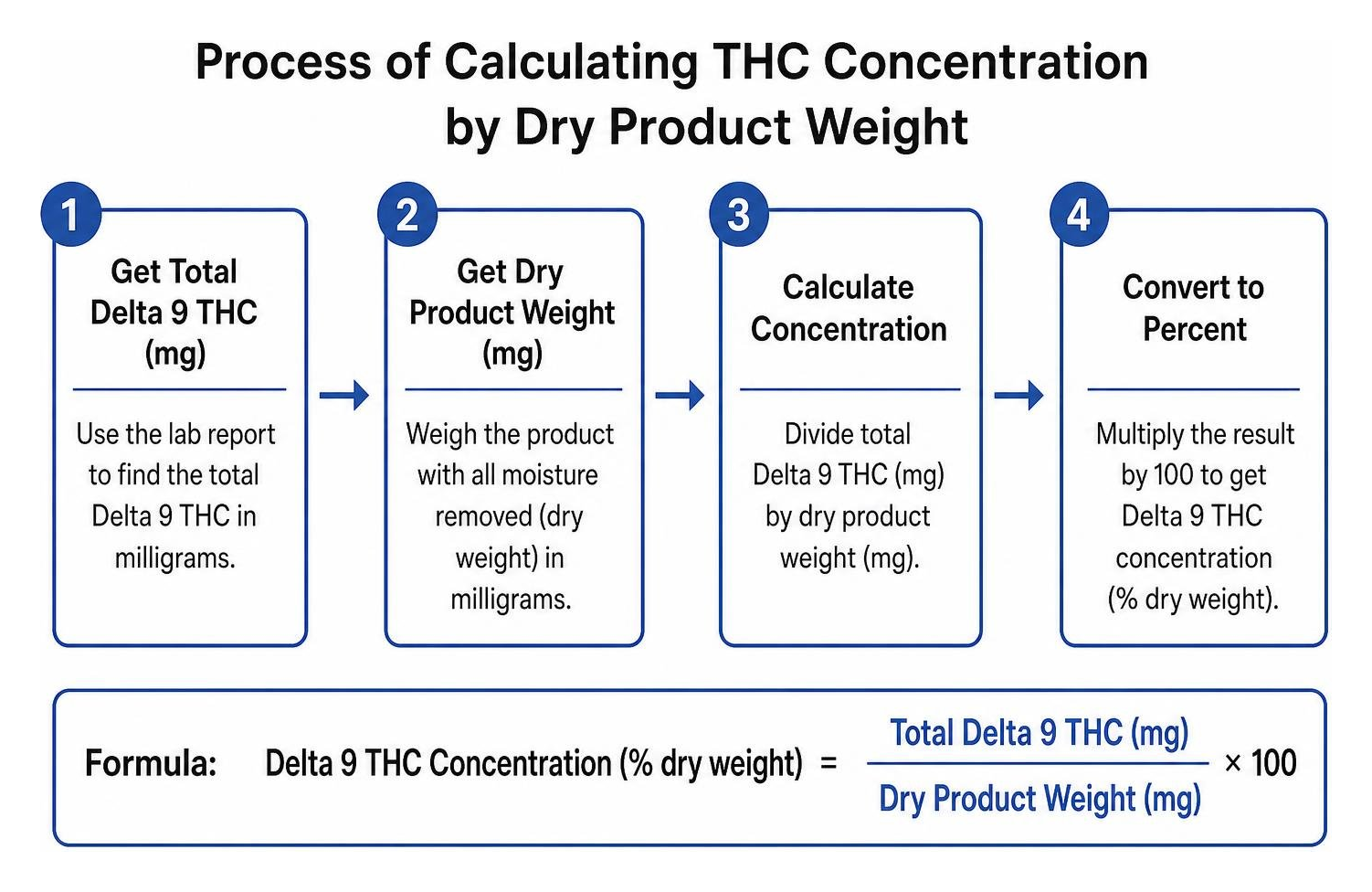
This concentration formula explains why hemp-derived edibles entered mainstream commerce. As outlined in Congressional research on hemp regulations, the distinction between legal hemp and restricted cannabis relied entirely on this concentration cutoff. In fact, research indicates that 96.2% of commercial hemp-derived Delta 9 products easily fit within the 0.3% dry-weight ceiling (Johnson et al., 2023).
Hemp-Derived vs. Marijuana-Derived Cannabinoids
Chemically speaking, hemp-derived Delta 9 THC and marijuana-derived Delta 9 THC are the exact same molecule. Both compounds interact identically with the human body's CB1 and CB2 cannabinoid receptors. The difference is purely legal:
- Hemp-Derived Delta 9: Extracted from cannabis plants containing 0.3% or less Delta 9 THC on a dry weight basis, falling under commercial agricultural frameworks.
- Marijuana-Derived Delta 9: Sourced from cannabis plants exceeding the 0.3% threshold, historically classified as a Schedule I controlled substance under federal law.
For a deeper dive into the chemical profile and effects of this cannabinoid, read our complete Delta 9 overview.
Delta 8 vs. Delta 9 vs. Delta 10: Legal Status and Sourcing
As the hemp market expanded, alternative isomers like Delta 8 and Delta 10 gained popularity alongside traditional Delta 9. When deciding between different formats, exploring our comparison of Delta 9 and Delta 8 helps clarify their distinct functional traits.
| Cannabinoid | Primary Source | Production Method | Relative Potency | Federal Status |
|---|---|---|---|---|
| Delta 9 THC | Hemp or Marijuana | Direct extraction or CBD cyclization | High (Baseline standard) | Federally legal under dry-weight and container limits |
| Delta 8 THC | Hemp (Trace amounts) | Acid-catalyzed cyclization from CBD | Moderate (~50–70% of Delta 9) | Legal federally if hemp-derived; restricted in many states |
| Delta 10 THC | Hemp (Trace amounts) | Chemical isomerization from CBD isolate | Mild (~30–50% of Delta 9) | Subject to varying state synthetic cannabinoid bans |
Is Chemically Converted Delta 8 Sourced Differently from Legal Delta 9?
While Delta 9 occurs naturally in meaningful quantities across cannabis plants, Delta 8 and Delta 10 exist only in minute, trace fractions. To produce commercial quantities of Delta 8 or Delta 10, processors use an acid-catalyzed chemical cyclization process to convert raw CBD isolate into these alternative isomers.
Scientific testing reveals that a significant portion of hemp Delta 9 is also produced this way; approximately 49% of commercial hemp Delta 9 products use THC converted from CBD through cyclization, while only 18.4% rely entirely on direct natural extraction (Johnson et al., 2023). Specialized laboratory markers, such as trans:cis Delta-9 THC ratios and the presence of Delta-8-iso-THC, allow chemists to identify whether a cannabinoid was naturally extracted or chemically converted (Johnson et al., 2023).
Potency, Intoxication, and Onset Differences
The differences between these cannabinoids stem from how their double-bond chemical structures bind to central nervous system CB1 receptors:
- Delta 9 THC: Possesses a double bond on the 9th carbon chain, yielding strong binding affinity and pronounced psychoactive effects.
- Delta 8 THC: Has its double bond on the 8th carbon chain, offering a milder, clearer high with lower reported rates of acute anxiety.
- Delta 10 THC: Features its double bond on the 10th carbon chain, generally producing subtle, daytime-oriented uplifting sensations.
When ingested in gummy form, all three cannabinoids pass through the digestive system and liver. Ingested Delta 9 metabolizes into 11-hydroxy-THC, a potent metabolite that typically takes 45 to 120 minutes to produce noticeable effects and can last 4 to 8 hours.
State-by-State Regulations and the 2026 Total-THC Rule
While federal statutes establish a national baseline, states retain broad authority to regulate, restrict, or outright prohibit consumable hemp products within their borders.

State Restrictions and Local Consumable Hemp Laws
Several states have enacted strict statutes limiting or banning intoxicating hemp-derived cannabinoids. For instance, the Texas consumable hemp program rules establish strict retail registration, enforce a 0.3% dry weight limit, require mandatory 21+ photo ID verification at checkout, and restrict synthetic cannabinoid variations.
Other states have redirected intoxicating hemp products exclusively into state-licensed adult-use dispensary channels or enacted near-zero milligram limits on consumable products, overriding the federal 0.3% dry-weight loophole at the state level.
How Total-THC Standards Impact Where Legal Delta 9 Is Sold
The regulatory landscape reached a turning point with recent federal statutory amendments, including Section 781 of Public Law 119-37. This framework introduced a strict finished-product cap of 0.4 milligrams of total THC per container and adopted a "total THC" calculation model:
Total THC = Delta-9 THC + (0.877 × THCA)
This rule accounts for the thermal conversion of non-intoxicating THCA into active Delta 9 THC. Additionally, the federal framework coordinates alongside broader administrative shifts, including formal DEA rescheduling analysis, which placed qualifying state-licensed medical marijuana formulations under Schedule III while maintaining distinct federal boundaries for commercial hemp.
Safety, Lab Testing, and Protecting Your Consumer Rights
Because the consumable hemp space evolved under minimal federal premarket review, consumers must proactively verify product quality and safety before purchasing.
The FDA regulation of cannabis products maintains that adding active cannabinoids to conventional foods or dietary supplements without formal premarket approval violates federal food safety standards. Consequently, ensuring proper Delta 9 gummy effects and dosing depends on independent lab transparency.
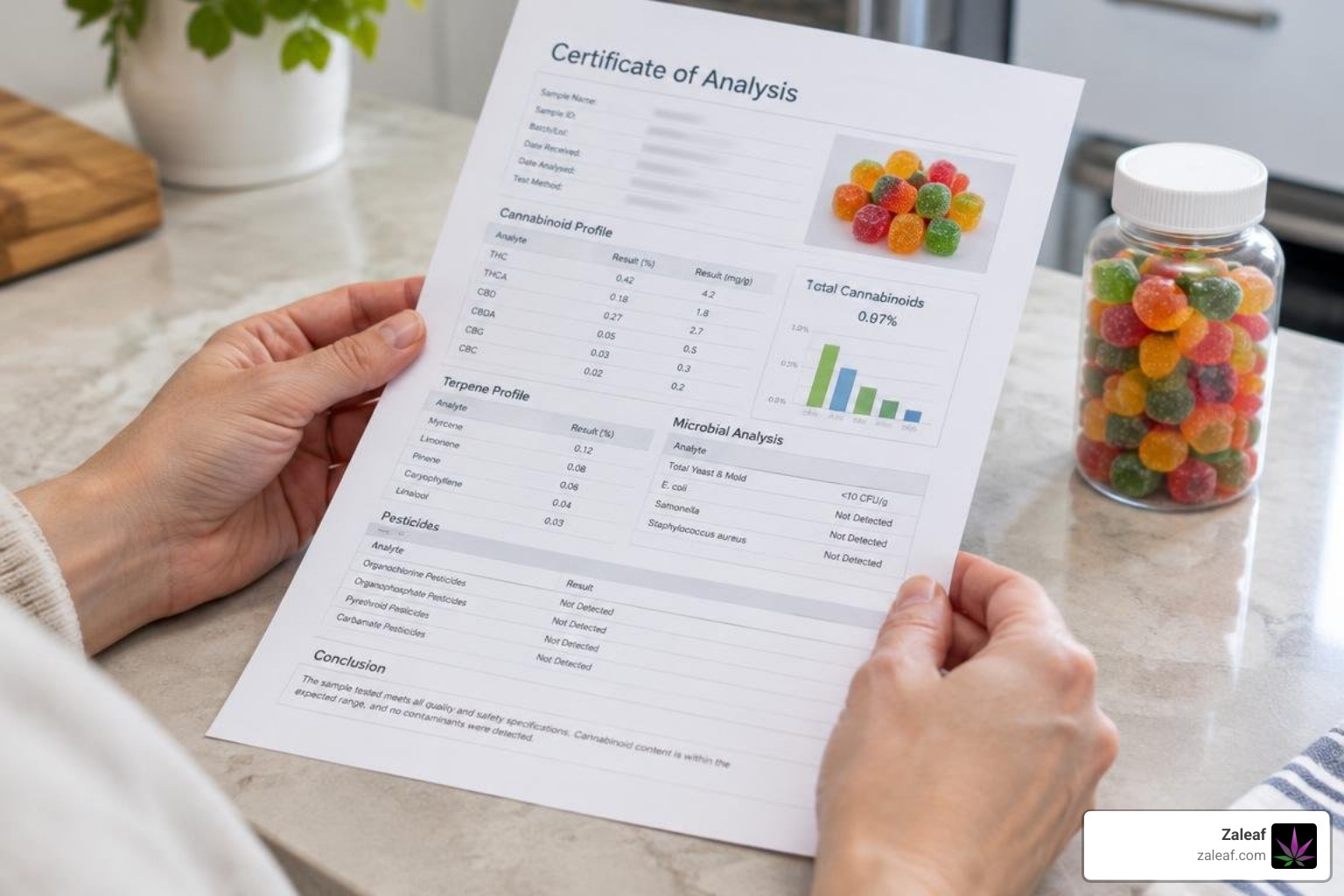
Reading Certificates of Analysis and Spotting Mislabeled Doses
Third-party lab testing is the only reliable way to confirm what is inside an edible. However, academic market evaluations reveal significant compliance gaps:
- Dosage Inaccuracies: 66.0% of commercial hemp Delta 9 products differ from their stated label dosage by more than 10%, with 88.6% of mislabeled items containing less THC than advertised (Johnson et al., 2023).
- Incomplete Panels: While 84.9% of hemp brands provide a Certificate of Analysis (COA), 71.1% of those reports only evaluate potency and fail to screen for contaminants like residual solvents, pesticides, heavy metals, or microbes (Johnson et al., 2023).
- Potency Spikes: The average advertised dose across tested hemp Delta 9 products is 12.98 mg per serving—higher than the standard 10 mg edible limit in recreational states like Colorado and California—with some single servings testing as high as 36.68 mg (Johnson et al., 2023).
When reviewing a COA, always match the batch number on the package to the lab document and ensure the report includes full contaminant screening alongside cannabinoid percentages.
Drug Test Detection and Responsible Consumption
A common misconception is that hemp-derived cannabinoids bypass workplace drug screenings. Standard immunoassay urine tests screen for THC-COOH, the primary inactive metabolite produced when the liver processes Delta 9 THC. Because hemp-derived Delta 9 is structurally identical to marijuana-derived THC, it converts into the exact same metabolites and will trigger a positive test result.
Furthermore, public health guidelines from CDC public health cannabis facts emphasize safe storage and moderation. Approximately 30% of cannabis consumers may experience some degree of cannabis use disorder over time.
Additionally, market research indicates that 81.1% of hemp Delta 9 products lack child-resistant packaging and only 15.1% of vendors enforce age verification at checkout (Johnson et al., 2023). Always secure your edibles in child-proof containers and store them away from minors.
Frequently Asked Questions About Hemp Edibles
Will legal Delta 9 show up on a workplace drug test?
Yes. Standard drug tests do not differentiate between THC sourced from legal industrial hemp and THC sourced from regulated marijuana. If you consume hemp Delta 9, your body produces THC-COOH metabolites that will result in a positive drug screen.
Why are high-potency Delta 9 gummies legally sold online?
The 2018 Farm Bill established legal compliance based on a dry-weight ratio of 0.3% Delta 9 THC. Because gummies and baked goods have substantial physical weight (such as 4 to 10 grams per piece), they can hold 10 to 30 milligrams of active THC without exceeding 0.3% of the total product mass.
How is hemp Delta 9 different from CBD?
Delta 9 THC is a psychoactive cannabinoid that binds directly to CB1 receptors in the brain, producing an intoxicating high. In contrast, CBD (cannabidiol) is non-intoxicating, modulates receptor activity, and does not produce an intoxicating effect on its own.
Conclusion
Understanding your rights and the evolving legal status of hemp cannabinoids is essential for safe, confident consumption. While the 2018 Farm Bill created broad access to hemp-derived Delta 9, shifting state laws, total-THC thresholds, and testing inconsistencies make consumer diligence critical.
At Zaleaf, we provide 100% legal, third-party lab-tested cannabis products featuring enhanced cannabinoid and terpene profiles formulated for mood-specific effects. We deliver directly to your door with fast shipping and discreet packaging, without requiring a medical card or ID at checkout. To keep expanding your cannabis knowledge, explore our complete library of Zaleaf educational cannabis guides.
References
Johnson L, Malone M, Paulson E, Swider J, Marelius D, Andersen S, Black D. "Potency and safety analysis of hemp delta-9 products: the hemp vs. cannabis demarcation problem.." Journal of cannabis research, 2023. PMCID PMC10369762.