

The Truth About Buying Cannabis Without a Medical Card

Understanding Cannabis Access With No Medical Card

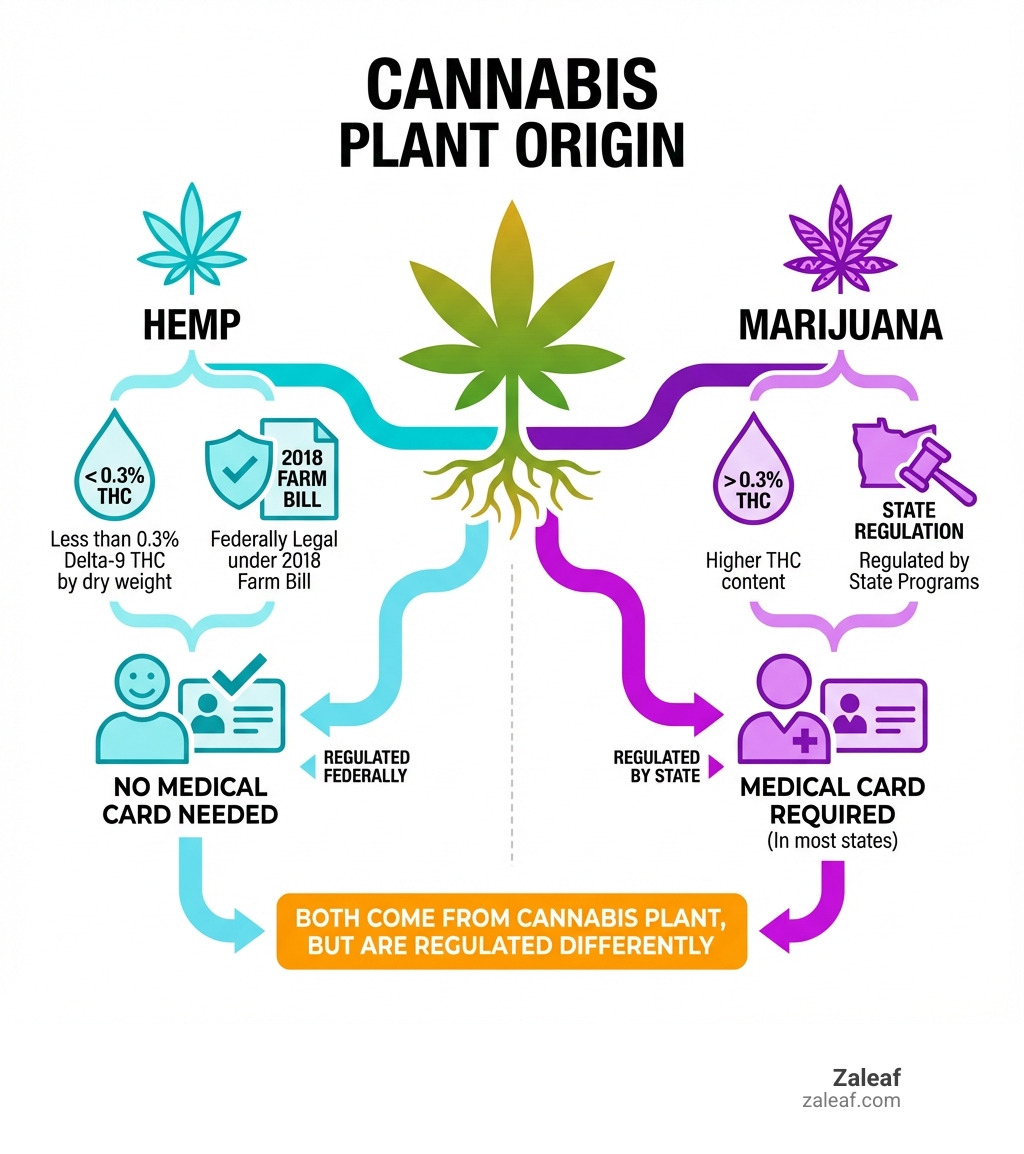
No medical card is required to purchase certain cannabis products in the United States, but the legality depends on whether you're buying medical marijuana or hemp-derived THC. Here's what you need to know:
- Medical Marijuana: Requires a state-issued medical card, doctor certification, and qualifying medical condition. Only available in 40+ states with medical programs.
- Hemp-Derived THC: Legal federally under the 2018 Farm Bill. No medical card needed. Must contain less than 0.3% Delta-9 THC by dry weight.
- Key Difference: Medical marijuana is state-regulated with higher THC content. Hemp-derived products are federally legal but vary by state.
- Your Legal Path: If you don't have a medical card, you can legally purchase hemp-derived THC products that meet federal guidelines.
If you've seen signs outside dispensaries advertising "No Medical Card Needed," you're not alone in wondering how this is possible. The answer lies in the 2018 Farm Bill, which created a legal pathway for hemp-derived cannabis products—completely separate from state medical marijuana programs.
This has created a booming market for legal cannabis products accessible to anyone 21 and older. But legality doesn't guarantee safety or quality. Without the oversight of medical marijuana programs, the hemp-derived market includes both reputable vendors and questionable operators. The Oklahoma Medical Marijuana Authority has warned that these unregulated products "pose health dangers due to a lack of testing and can be sold to anyone."
I'm Max Shemesh from Zaleaf, and I've spent years navigating the complex cannabinoid industry to help customers access legal, tested products with no medical card required. This guide will clarify exactly what you can legally buy, how to stay safe, and what the future holds for cannabis regulation.
Learn more about no medical card:
The "Farm Bill Loophole": How It's Possible to Buy THC Without a Card
The term "Farm Bill loophole" is the key to understanding how you can purchase THC products with no medical card. This stems from the 2018 Farm Bill, a federal law that significantly reshaped the cannabis landscape.
Before 2018, all cannabis plants were federally illegal Schedule I controlled substances. The 2018 Farm Bill changed this by drawing a crucial distinction between hemp and marijuana.

Under this bill, hemp was removed from the controlled substances list and redefined as an agricultural commodity, provided it contains less than 0.3% Delta-9 THC on a dry weight basis. Delta-9 THC is the primary psychoactive compound in cannabis. Any cannabis plant exceeding this 0.3% threshold is still classified as marijuana and remains federally illegal.
This reclassification meant that hemp-derived products, including those with cannabinoids like CBD, Delta-8 THC, and even small amounts of Delta-9 THC (as long as they stay under the 0.3% limit), became federally legal. This opened the door for a wide array of products to be sold and shipped across state lines without a medical card.
However, while federally legal, individual states can enact their own regulations. Some states have accepted the federal framework, while others have moved to restrict or ban certain hemp-derived cannabinoids, creating a complex patchwork of laws.
To dive deeper into this foundational legislation, we encourage you to explore our guide, The Farm Bill Explained: Your Guide to Hemp Legality.
Medical Marijuana vs. Legal Hemp-Derived THC
The distinction between medical marijuana and hemp-derived THC is critical. While both can offer therapeutic effects, their legal frameworks, potency, and accessibility differ significantly.
Medical Marijuana Programs: These are state-level initiatives providing cannabis to patients with specific qualifying medical conditions. Access requires a state-issued medical card from a doctor. These programs regulate potency, product types, and dispensary operations within the state.
Legal Hemp-Derived THC: This category emerged from the 2018 Farm Bill. Products derived from this federally legal hemp, such as Delta-8 THC and Delta-9 THC edibles that adhere to the 0.3% dry weight limit, do not require a medical card. They are often sold online and in retail stores.
Here's a quick comparison:
| Feature | Medical Marijuana | Hemp-Derived THC (e.g., Delta-8, Farm Bill Compliant Delta-9) |
|---|---|---|
| Legal Source | State-level medical cannabis laws | 2018 Federal Farm Bill |
| THC Limit | Typically higher, regulated by state | Less than 0.3% Delta-9 THC by dry weight |
| Card Required | Yes, a state-issued medical card | No medical card needed |
| Age Limit | Varies by state (often 18+ with card) | Typically 21+ (similar to alcohol/tobacco) |
| Availability | State-licensed dispensaries | Online, CBD stores, some retail outlets |
This table illustrates how consumers can distinguish between the two. If you need a medical card at a state-licensed dispensary, you're buying medical marijuana. If you're purchasing online or from a retail store with no medical card requirement, you're buying hemp-derived products.
The Rise of Hemp-Derived Cannabinoids
The 2018 Farm Bill inadvertently paved the way for a new category of psychoactive cannabinoids derived from hemp. This includes compounds like Delta-8 THC, Delta-10 THC, HHC, and "Farm Bill compliant" Delta-9 THC products.
Delta-8 THC, in particular, has seen a meteoric rise in popularity. Consumers often describe its effects as a milder, clearer high compared to traditional Delta-9 THC. Our article, Are Delta-8 Gummies Legal? Clearing the Haze Around THC Treats, digs into its legal status.
The legality of these cannabinoids hinges on the "less than 0.3% Delta-9 THC" clause. Manufacturers often convert hemp-derived CBD into other cannabinoids like Delta-8 THC. Since the final product's Delta-9 THC content remains below the federal threshold, these products are considered federally legal. This has created a booming market, making cannabis-like effects accessible to a broader consumer base with no medical card needed.
Navigating the Market When You Have no medical card
While the Farm Bill has opened doors for accessible THC products with no medical card required, it has also created an inconsistent market. Because these products often fall outside the stringent regulations of state medical marijuana programs, the market includes both highly reputable vendors and those cutting corners on safety and quality.

One of the biggest concerns is potential health risks. As the Oklahoma Medical Marijuana Authority (OMMA) has pointed out, a "lack of testing" means consumers might unknowingly purchase products with contaminants or inaccurate potency. We've seen our share of "Gummy Bear or Gummy Beware" scenarios, as highlighted in our article Gummy Bear or Gummy Beware: The Truth About THC Gummies Legality.
This is why third-party lab testing is non-negotiable. A Certificate of Analysis (COA) from an independent lab provides a transparent look into your product's safety, purity, and potency. Always prioritize vendors who readily provide COAs for all their products.
Why Product Testing is Crucial for Purchases with no medical card
When buying hemp-derived THC products, independent testing is crucial for several reasons:
- Consumer Safety: Untested products can contain harmful contaminants like pesticides, heavy metals, or residual solvents. Third-party testing screens for these, ensuring a clean and safe product.
- Accurate Dosing: Inaccurate potency labeling is a common issue. A COA verifies the exact cannabinoid content (Delta-8 THC, Delta-9 THC, CBD, etc.), allowing you to dose accurately and avoid surprises.
- Product Purity: Testing confirms the product contains what it claims to and isn't diluted or filled with unlisted synthetic cannabinoids.
- Terpene Profiles: For those who appreciate the nuanced effects and flavors of cannabis, terpene analysis is key. A good COA details the terpene profile, helping you choose products for specific moods.
At Zaleaf, all our products undergo rigorous 3rd party testing because you deserve to know exactly what you're putting into your body.
How to Read a Certificate of Analysis (COA)
A Certificate of Analysis (COA) is the report card for your cannabis product. Learning to read it empowers you to make safe and informed decisions.
Here’s what to look for:
- Cannabinoid Profile: Lists concentrations of cannabinoids like Delta-9 THC, Delta-8 THC, and CBD. Verify that the Delta-9 THC is below 0.3% by dry weight for federal compliance.
- Terpene Analysis: A comprehensive COA will detail the dominant terpenes and their concentrations, which helps you understand the product's potential effects and flavors.
-
Contaminant Testing: Look for a "Pass" or "ND" (Not Detected) for harmful substances like:
- Pesticides
- Heavy Metals (Lead, arsenic, etc.)
- Residual Solvents (Butane, ethanol, etc.)
- Microbials (Mold, bacteria, etc.)
- Matching Batch Numbers: Cross-reference the batch number on your product with the one on the COA to ensure they match.
- Laboratory Information: The COA should clearly state the name and accreditation (e.g., ISO 17025) of the third-party testing lab.
Reviewing the COA is an essential step when purchasing products with no medical card, providing the transparency that might otherwise be missing. For a deeper dive, check out our guide on Beyond the Label: Demystifying Third-Party Testing.
The Shifting Legal Landscape and the Future of Cannabis
The cannabis industry is constantly evolving, particularly concerning the laws around hemp-derived products available with no medical card.
Many states, concerned about the "loophole" created by the Farm Bill, are cracking down on these items. For instance, officials in Oklahoma have highlighted the "lack of testing" and potential health dangers of unregulated products, leading to new laws for stricter oversight. This trend shows that states are asserting more control, and businesses must steer evolving state laws carefully to avoid penalties. This highlights the legal risks for any business advertising 'No Medical Card Needed' without understanding the nuances of state vs. federal law.
On a federal level, a monumental shift is underway. In May 2024, the Department of Justice (DOJ) proposed transferring marijuana from Schedule I to Schedule III of the Controlled Substances Act. This follows recommendations from health agencies and acknowledges cannabis's accepted medical use and lower abuse potential. This potential rescheduling would be a significant development, paving the way for broader research and more accessible medical use. This federal movement, combined with state-level adjustments, paints a picture of a rapidly changing market. To explore these future legal perspectives, check out our article: Is No Medical Card Needed? The Future: A Legal Perspective.
State vs. Federal Law: Understanding the Conflict for sales with no medical card
The cannabis industry operates where state and federal laws often diverge. At the federal level, marijuana (excluding Farm Bill-compliant hemp) remains a Schedule I substance, implying it has no accepted medical use. However, a majority of states have legalized cannabis for medical or recreational use, creating a direct conflict.
The 2018 Farm Bill further complicates this dynamic. While federal law permits hemp-derived THC products to be sold with no medical card needed, states are increasingly stepping in to regulate or ban them, arguing they should be treated like marijuana.
This regulatory confusion creates challenges. For consumers, it means a product legal in one state might be illegal across the border. The proposed federal rescheduling of cannabis to Schedule III would be a game-changer. It would acknowledge its medical use, reduce federal penalties, and could ease the tension between state and federal laws. Until then, understanding the specific laws of your state remains paramount.
The Farm Bill's loophole forces states to confront how they want to regulate all cannabis products, pushing for more cohesive, science-backed regulations that protect consumers.
Frequently Asked Questions
Understanding the nuances of buying THC products with no medical card can be tricky. Here, we address some of the most common questions.
Is it legal to buy THC products online?
Yes, it is federally legal to buy hemp-derived THC products online if they comply with the 2018 Farm Bill (containing less than 0.3% Delta-9 THC by dry weight). This allows online retailers like us to offer 100% legal cannabis products with fast, discrete shipping.
However, some states have their own restrictions on certain cannabinoids like Delta-8 THC. We always recommend checking your local laws before purchasing. Reputable online vendors will not ship to restricted areas.
Can I travel with hemp-derived THC products?
Traveling with hemp-derived THC products can be risky, even though they are federally legal.
- State Bans: If you travel into a state that has banned a particular cannabinoid (like Delta-8 THC), you could be violating local laws.
- TSA Guidelines: The TSA's primary focus is security, but they must report suspected illegal substances to law enforcement. It can be difficult for an agent to differentiate between legal hemp and illegal marijuana without a lab test, which could lead to delays or confiscation.
Our advice is to err on the side of caution. Check the laws of your destination and consider leaving your products at home to avoid any potential hassle, especially when flying.
How can I be sure a product is legal and safe?
Ensuring the legality and safety of your hemp-derived THC products, especially when you have no medical card, comes down to a few key practices:
- Choose Reputable Online Vendors: Look for companies with a strong track record, positive reviews, and transparent business practices.
- Demand Third-Party Lab Tests (COAs): This is non-negotiable. Every product should have an accessible COA from an independent lab verifying its potency (is it Farm Bill compliant?) and purity (is it free of contaminants?).
- Check Product Labeling: Labels should clearly state the cannabinoid content, ingredients, and batch numbers that match the COA.
- Understand Your State's Laws: Stay informed about your local regulations regarding hemp-derived cannabinoids, as they can change.
By following these guidelines, you can confidently enjoy legal, safe, and high-quality hemp-derived THC products.
Conclusion
The 2018 Farm Bill created a legal pathway for consumers to purchase THC products with no medical card by legalizing hemp-derived cannabinoids under the 0.3% Delta-9 THC threshold. This has empowered millions to explore the benefits of cannabis without the traditional problems of medical programs.
However, this accessibility comes with a critical caveat: the market is less regulated than state-run dispensaries, making consumer diligence essential. To ensure you are buying safe and legal products, always choose reputable vendors who provide comprehensive third-party lab tests (COAs) for every item. Understanding these COAs and your local state laws is crucial for navigating the market safely.
At Zaleaf, we are committed to providing 100% legal, third-party tested cannabis products that meet the highest standards of safety and quality. We believe everyone should have access to enhancing cannabinoid and terpene profiles that offer mood-specific effects, delivered discreetly and efficiently, with no medical card needed.
As the legal landscape continues to shift, staying informed and choosing trusted sources will remain paramount. Accept the freedom the Farm Bill has provided, but always do so with knowledge and care. For more insights on navigating your online cannabis product purchases, explore our guide: From Click to Cloud: Navigating Online Cannabis Product Purchases.