

The Secret Life of No ID: Places and Activities Where Your Papers Aren't Needed

Why Understanding No ID Required Situations Matters

Knowing when no ID required situations apply can simplify your life and protect your privacy. Whether you've lost your wallet or just prefer to keep your information private, understanding your options gives you more control. Here's a quick overview:
Common No ID Required Situations:
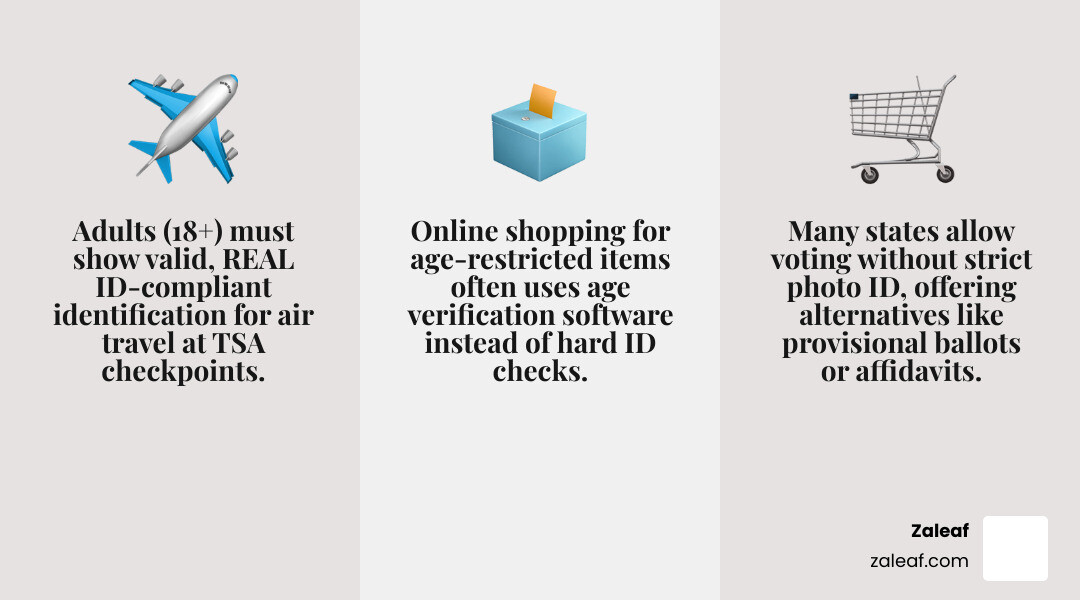
- Voting in most states - Many states allow voting without photo ID via provisional ballots or affidavits.
- Public spaces - Parks, libraries, and free public events are generally open to all.
- Emergency medical care - Emergency rooms must treat patients regardless of ID.
- Online shopping - Age verification software often replaces hard ID checks.
- Children under 18 - The TSA doesn't require ID for minors on domestic flights with parents.
- Certain retail purchases - Most non-age-restricted items don't require ID.
While adults need a valid ID for air travel, many other essential activities don't require you to show your papers. For example, California generally doesn't require voter ID at the polls, and children under 18 can fly domestically without it.
I'm Max Shemesh, founder of Zaleaf. In the cannabinoid industry, I've seen how confusing ID rules can be, especially for legal products where no ID required options exist for age-verified online purchases. My experience has shown me the importance of clarifying when identification is truly necessary.
Common No ID required vocab:
Voting Without ID: Your Rights at the Polls

When it comes to voting, ID requirements can be confusing. The truth is, voter ID laws vary by state, and in many places, you can cast a ballot without a government-issued photo ID. This flexibility is crucial for ensuring every eligible citizen can participate in our democracy.
Voting with No ID Required: State-by-State Differences
Different states handle the "no ID required" scenario in various ways. For instance:
In California, voters are generally not required to show ID at the polls. An ID might only be requested from first-time federal election voters who registered by mail without providing identification, and even then, a non-photo document like a utility bill is often sufficient. More details are at the California Voter ID & Registration Requirements page.
In states like Michigan and Virginia, if you don't have a photo ID, you can sign an affidavit affirming your identity and cast a regular ballot. This ensures a lack of ID doesn't disenfranchise voters.
In Washington, if you can't provide an acceptable photo ID, you'll be issued a provisional ballot. This ballot is counted if the signature on it matches your voter registration record.
These examples show that many states have built-in mechanisms to accommodate voters without ID.
What Happens If You Don't Have ID to Vote?
If you arrive at the polls without ID, don't panic. Many states offer alternative verification methods to ensure your vote counts. The most common are:
Casting a Provisional Ballot: This ballot is set aside and counted after your eligibility is confirmed. In states like Arizona and Arkansas, you may need to present your ID to an election official within a few days after the election for your vote to be counted.
Signing an Affidavit of Identity: As seen in Michigan and Virginia, you can sign a sworn statement affirming your identity to cast a regular ballot.
Signature Verification: In states like Washington, your signature on a provisional ballot is compared to the one on file from your voter registration.
A large number of states have non-strict voter ID laws that allow for these kinds of alternatives. While some states have stricter photo ID laws, they still provide options, such as allowing supporting documents if you have a reasonable impediment to obtaining a photo ID. This widespread use of alternative procedures demonstrates a commitment to voter access.
Exceptions and Special Cases
Beyond the standard alternatives, some special cases broaden the "no ID required" landscape for voting:
First-Time Voters (HAVA): The Help America Vote Act (HAVA) may require first-time voters who registered by mail to show ID, but this often includes non-photo documents like a utility bill.
Religious Objections: Some states have provisions for voters with religious objections to being photographed, allowing them to bypass photo ID requirements.
Vouching: In West Virginia, a poll worker who has known a voter for at least six months can vouch for their identity.
These safeguards ensure that a simple lack of ID doesn't prevent you from voting. For specific rules, always check your state's election commission website, like the Georgia Voter Identification Requirements page.
Navigating a World with No ID Required: Key Scenarios
Beyond the ballot box, many everyday situations don't require a formal, government-issued ID. Understanding these "no ID required" scenarios can make your life much smoother.
General Daily Activities
For many routine interactions, an ID is unnecessary. Here are some common examples:
- Public Parks and Libraries: Accessing public spaces like parks and libraries is almost universally "no ID required."
- Most Retail Shopping: Unless you're buying age-restricted items (like alcohol or tobacco), you won't need an ID for groceries, clothes, or electronics.
- Attending Free Public Events: Concerts in the park, farmers' markets, and street festivals usually don't ask for ID at the entrance.
- Exercising Rights of Assembly: When participating in peaceful protests or rallies, you are generally not required to show identification to law enforcement unless there is reasonable suspicion of a crime.
Exceptions for Minors
Minors often operate under different rules and enjoy a broad "no ID required" status.
- TSA Rules for Children: The TSA explicitly states that children under 18 do not need to provide identification when traveling domestically within the United States, simplifying family travel.
- General Purchases: Like adults, minors can purchase non-age-restricted items without an ID.
- Parental Consent: For many activities, a parent's presence or consent acts as authorization for a minor, negating the need for a formal ID.
Medical Services and Prescriptions
When it comes to healthcare, emergency medical care is a critical area where no ID required is an enshrined principle.
- Emergency Room Access: Under the Emergency Medical Treatment and Labor Act (EMTALA), hospitals must provide emergency treatment to anyone, regardless of their ability to present identification. Billing information is collected later and does not delay life-saving care.
- State-Specific Requirements for Medical Cannabis: This area has more variability. Obtaining a medical cannabis card usually requires a government-issued ID. The card itself then acts as your ID for purchases. For example, Georgia requires a photo ID and a state-issued Low THC Oil Registry Card to pick up an order. If you're curious about navigating legal cannabis, our blog post Learn about legal cannabis access offers more insights.
When an ID is Missing: Alternatives and Consequences
It happens: you lose your wallet or never acquired a government-issued ID. While many situations are "no ID required," its absence can be a hurdle. Understanding the alternatives and consequences is key.
Alternatives to Standard Photo ID
If an ID is requested but you don't have one, there are often alternatives:
- Provisional Ballots and Affidavits: As discussed for voting, these are official procedures to protect your rights.
- Identity Verification Process (TSA): For air travel, the TSA may use an identity verification process if you lack an acceptable ID. If confirmed, you'll be allowed to proceed with additional screening.
- Secondary Documents: For some processes, you can use secondary documents like a Social Security card, birth certificate, utility bills, or bank statements to corroborate your identity.
- Digital IDs: Some states are issuing mobile driver's licenses (mDLs) that can be used in certain situations, representing a growing alternative.
Consequences of Not Having a Required ID
When an ID is mandated, not having one can lead to issues:
- Denied Entry: You may be denied entry to flights, secure buildings, or events.
- Inability to Complete Transactions: You may be unable to open a bank account, buy age-restricted items, or access certain government services.
- Legal Issues: In some states with "stop and identify" laws, failing to produce ID when lawfully requested by law enforcement can lead to problems.
- Missed Opportunities: Job applications and social services often require identity verification.
How to Replace Lost or Stolen Documents
If your ID is lost, act quickly to replace it. Contact the appropriate agency for each document:
- Social Security Card: Visit the Social Security Administration website.
- Birth Certificate: Contact your birth state's vital records office. The CDC has a resource page: Birth certificate.
- Driver's License/State ID: Contact your state's DMV or equivalent agency.
- U.S. Passport: Report it to the State Department and request a replacement. See the U.S. passport page.
- Green Card: File Form I-90 with U.S. Citizenship and Immigration Services. Details on how to replace your Green Card are available online.
The Digital Age: Online Verification and Purchases
The internet has revolutionized how we verify identity, often creating pathways where a physical ID isn't needed. This is especially true for online shopping, where age verification software often steps in.
Online Shopping with No ID Required: What to Know
For many online purchases, the concept of "no ID required" is built into the system.
- Age Verification Software: Instead of asking for an ID upload, many e-commerce sites use software that cross-references public databases with your name, address, and date of birth to confirm your age. This allows you to complete a purchase without showing your ID to the merchant.
- Privacy Policies: These systems balance compliance with privacy, typically relying on a secure age check without storing your sensitive ID documents.
- Direct-to-Consumer Sales: At Zaleaf, we offer 100% legal cannabis products with fast, discrete shipping. Our robust age verification system means no ID required at the point of sale for many products. Learn more in our guide on How to Buy Delta 8 Without Flashing Your ID.
The Rise of Digital IDs
Digital IDs and mobile driver's licenses (mDLs) are emerging as convenient alternatives to physical cards.
- Mobile Driver's Licenses (mDLs): Several states now offer mDLs, which are digital versions of your license stored on your smartphone. They are designed to be secure and compliant with REAL ID standards.
- TSA Acceptance: The TSA is a leader in adopting this technology, accepting certain mDLs from approved states at some checkpoints. This points to a future where a physical card may not always be necessary, but universal acceptance is still in progress.
Buying Vapes and THC Products Online
This is an area where the "no ID required" concept is particularly relevant for consumers seeking convenience and discretion.
- State Laws: The legality and ID requirements for buying these products online are dictated by state and local laws. Zaleaf ensures all our products are 100% legal where we ship.
- Age Gates vs. Hard ID Checks: Many online retailers use simple "age gates," but more robust systems confirm your age without requiring an ID upload. This provides a truly no ID required experience at purchase.
- Discrete Shipping: Companies like Zaleaf focus on discrete packaging and fast shipping, enhancing the convenience of online purchasing without in-person ID checks. Our How to Buy Delta 8 Without Flashing Your ID guide dives deeper into this topic.
Frequently Asked Questions about "No ID Required"
We've covered a lot, but you might still have questions about when an ID isn't needed. Here are some common FAQs.
Are there any federal programs that offer free or alternative identification?
While there isn't a single federal program, many states and districts offer free or low-cost non-driver ID cards to help vulnerable populations.
- The District of Columbia (DC DMV) offers free non-driver ID cards to seniors, recent returning citizens, and homeless residents. Learn more at the Eligibility for Free Non-Driver ID page.
- North Carolina's DMV offers free state ID cards to residents 17 and up, with exceptions for younger individuals who are blind, homeless, or have certain disabilities. More information is on their I Need a State ID page.
These initiatives help ensure everyone can obtain the identification needed for daily life.
What's the difference in ID requirements for air travel versus voting?
The requirements are very different, reflecting distinct security and access concerns.
- Air Travel: The TSA has strict federal rules. Adults 18 and older must show a valid, acceptable photo ID (soon to be a REAL ID-compliant one). Without it, you face a rigorous identity verification process and may be denied boarding. The focus is on national security.
- Voting: ID laws are set by states and are much more varied. Many states have no ID required scenarios, allowing alternatives like non-photo IDs (utility bills), signed affidavits, or provisional ballots. The goal is to balance election integrity with voter access.
Can I use an expired ID?
It depends entirely on the situation.
- For Air Travel (TSA): The TSA may accept an ID for up to two years after its expiration date for domestic travel. However, a current ID is always best.
- For Voting: This varies by state. Some states accept expired IDs, especially for older voters, while others require them to be current. Check your local laws.
- For Other Transactions: Most official business (banking, government agencies) requires a current, unexpired ID. Expired IDs are generally not accepted.
Conclusion
We've explored the surprising world of "no ID required" situations, from voting to online shopping. While a government-issued ID is essential for high-security activities like air travel, many tasks can be done without it, thanks to alternative verification methods and digital solutions.
Understanding these nuances empowers you, protecting your privacy and clarifying your rights. At Zaleaf, we believe in making legal products accessible. We've created a seamless online experience for our 100% legal cannabis products, using robust age verification so you can enjoy fast, discrete shipping—often with no medical card needed.
The landscape of identification is always evolving, but knowledge helps us steer it with confidence. For those interested in the legal frameworks governing cannabis products, we invite you to Learn more about THC vape laws in Texas.