

The Best Way to Mail Cannabis (And Why You Probably Shouldn't)
The Real Risks of How to Ship Weed (Before You Even Think About It)

If you're wondering how to ship weed, here's the short answer:
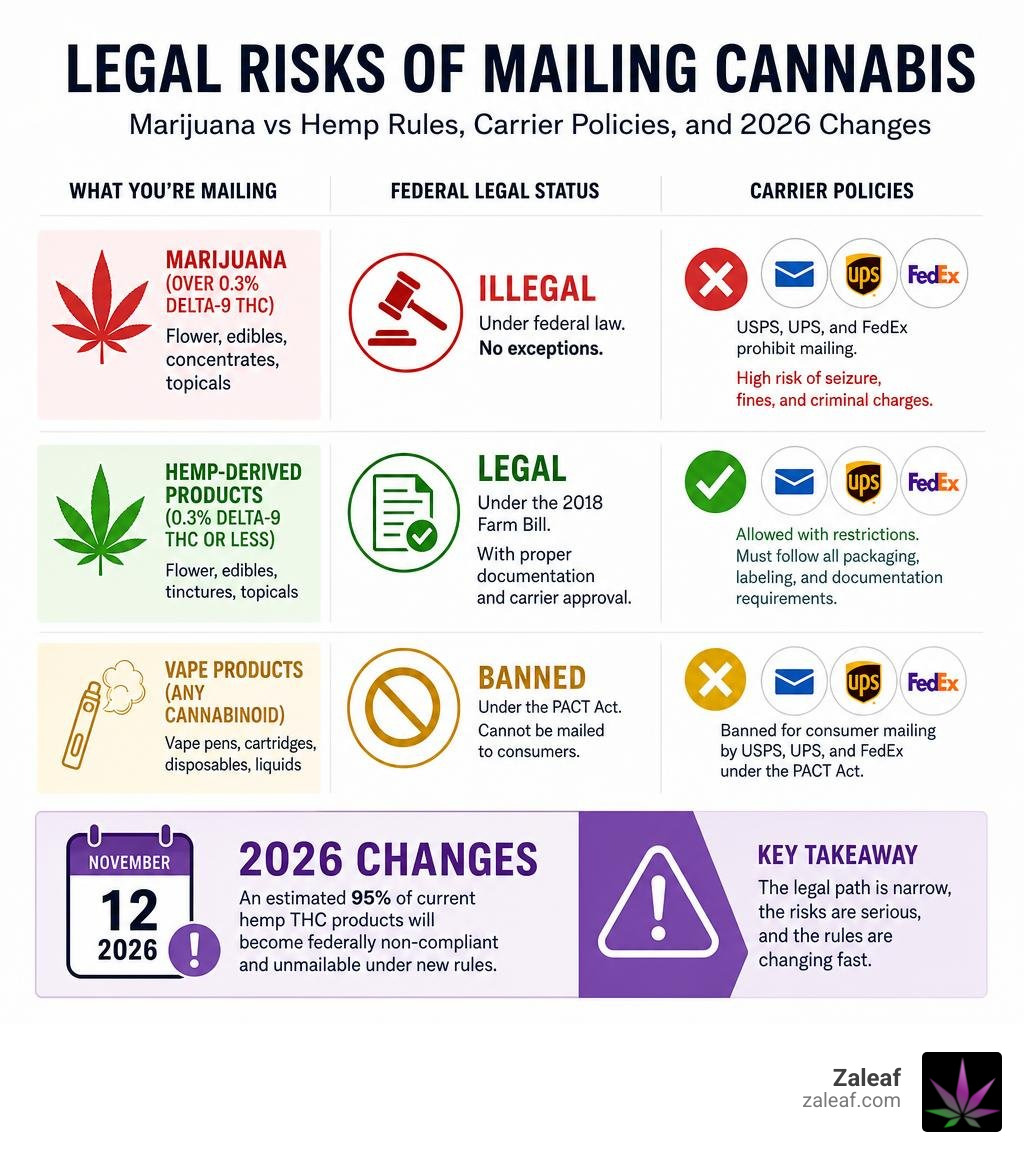
- Marijuana (over 0.3% Delta-9 THC): Illegal to mail under federal law. Full stop — no exceptions, even between two legal states.
- Hemp-derived products (0.3% Delta-9 THC or less): Legal to mail under the 2018 Farm Bill, with proper documentation and carrier approval.
- Vape products (any cannabinoid): Banned for consumer mailing by USPS, UPS, and FedEx under the PACT Act.
- After November 12, 2026: An estimated 95% of current hemp THC products will become federally non-compliant and unmailable under new rules.
The bottom line? The legal path is narrow, the risks are serious, and the rules are changing fast.
The USPS processes 23.8 million packages every single day. That sounds like good cover — until you realize the agency also employs 1,200 postal inspectors and made 2,110 drug-related arrests in a single year. Mailing cannabis is a federal crime punishable by up to five years in prison and a $250,000 fine, even for a small amount. State-level legalization doesn't change that math. The moment a package enters the federal mail system, federal law applies.
This guide walks through exactly what's legal, what's not, what carriers actually do when they find something suspicious, and what your real options are if you want cannabis delivered safely and discreetly.
I'm Max Shemesh, Owner and CEO of Zaleaf, and I've spent years navigating the complexities of legal cannabinoid distribution — including the compliance frameworks that govern how to ship weed and hemp-derived products across state lines. That experience is the foundation of everything we'll cover here.
The Legal Risks and Realities of How to Ship Weed
When we talk about the legalities of shipping cannabis, we have to look directly at the Controlled Substances Act (CSA). Under federal law, marijuana is classified as a controlled substance. Because the United States Postal Service (USPS) is a federal agency, and because shipping packages across state lines falls under interstate commerce, any use of the mail system to transport marijuana is a federal crime.
It does not matter if you are mailing a single joint from Oregon to California—two states where recreational use is completely legal. The moment that package crosses into federal jurisdiction, state laws cease to protect you. Doing so constitutes a federal felony, which carries penalties of up to five years in federal prison and a $250,000 fine for a first offense involving small amounts. If larger quantities are involved, or if prosecutors decide to tack on conspiracy charges, those mandatory minimum sentences can jump to five, ten, or twenty years.
Even with the recent federal movement toward rescheduling marijuana to Schedule III, this shift does not authorize the commercial or personal interstate shipping of state-licensed medical or adult-use marijuana. Rescheduling changes how the drug is treated for research and tax purposes, but it does not legalize unregulated transport.
How to Ship Weed Legally: Hemp vs. Marijuana Under Federal Law
The legal landscape looks completely different when we compare marijuana-derived products to those derived from hemp. This distinction is the absolute core of understanding how to ship weed legally.
The legal boundary is defined by a single number: 0.3%.
Under federal law, any cannabis plant (or product derived from it) that contains 0.3% or less Delta-9 THC on a dry-weight basis is classified as hemp. Anything containing more than 0.3% Delta-9 THC is classified as marijuana.
While marijuana remains federally illegal and unmailable, hemp-derived products—including CBD oils, topical creams, and certain low-THC edibles—are federally legal to ship under strict conditions. However, navigating these regulations as an individual is highly complex. For a deeper dive into how these rules apply to everyday consumers, you can read about the USPS Rules, Carrier Policies, and the November Hemp Ban Countdown.
Because of these strict guidelines, many consumers choose to skip the risk of DIY shipping entirely. Instead, they buy directly from compliant online vendors. If you want to know how to safely purchase compliant products online, check out our guide on how to find discreetly delivered legal online cannabis delivery.
The 2018 Farm Bill and the November 12, 2026 Hemp Redefinition Cliff
The 2018 Farm Bill was the landmark legislation that opened the floodgates for the legal hemp market. By removing hemp from the Controlled Substances Act, it allowed for the legal sale and shipment of hemp-derived cannabinoids across the country.
However, we are rapidly approaching a massive regulatory shift. On November 12, 2026, Section 781 of H.R. 5371 is scheduled to take effect. This federal hemp redefinition will replace the current 0.3% dry-weight Delta-9 THC limit with a strict 0.4mg total THC per container cap.
Industry groups estimate that roughly 95 percent of current hemp-derived intoxicating products on the market today will become federally non-compliant overnight once this law takes effect. This means that high-potency hemp gummies, which are currently legal to mail because they fall under the 0.3% dry-weight limit, will become illegal contraband to ship after November 12, 2026.
If you regularly purchase or ship hemp-derived edibles, this deadline is a critical "cliff" date. You can learn more about how this upcoming restriction will impact the availability of your favorite products by reading our guide to thc gummies delivery.
Carrier Policies: USPS vs. Private Couriers
A common misconception is that private shipping companies like United Parcel Service (UPS) or FedEx are safer options for shipping cannabis than the public post office. In reality, the exact opposite is true due to constitutional protections.
The USPS, as a federal agency, is bound by the Fourth Amendment of the U.S. Constitution, which protects citizens against unreasonable searches and seizures. This means that a postal inspector cannot simply open your package because they have a hunch. To open a class of mail sealed against inspection (such as First-Class Mail or Priority Mail), the USPS must obtain a federal search warrant signed by a judge, based on probable cause.
Private carriers like UPS and FedEx are private corporations. They are not bound by the Fourth Amendment. When you ship a package with a private carrier, you agree to their terms of service, which explicitly grant them the "right to inspect" any package at their own discretion, without a warrant. If a UPS or FedEx employee suspects a package contains cannabis, they can open it immediately, seize it, and turn it over to local law enforcement.
| Carrier | Marijuana Policy | Hemp/CBD Policy | Search Policy |
|---|---|---|---|
| USPS | Prohibited (Federal Crime) | Allowed (Must comply with Pub 52) | Requires federal warrant (4th Amendment) |
| UPS | Prohibited | Allowed (Contract/Account-only) | Right to inspect without a warrant |
| FedEx | Prohibited | Allowed (Highly restricted) | Right to inspect without a warrant; high seizure rate |
Carrier Policies: Why You Can't Just Ask How to Ship Weed via UPS or FedEx
If you walk up to a UPS Store counter with a box of hemp-derived CBD and ask to ship it, there is a very high chance the franchisee will refuse the shipment. Both UPS and FedEx have strict corporate policies that require shippers to have a pre-approved, contractual agreement to ship hemp or CBD.
Furthermore, UPS has a strict "co-location" policy. They will not accept legal hemp shipments if they originate from a physical location that also sells marijuana. FedEx maintains an even more aggressive operational posture. They have a reputation for high seizure and package destruction rates, often refusing to return or forward packages containing legal hemp if they do not have the exact contractual paperwork on file.
For a complete breakdown of how to navigate these carrier limitations safely, read our comprehensive discreet weed delivery guide 2026.
USPS Publication 52 and the PACT Act Vape Ban
For those shipping legal hemp-derived products via the public mail system, the bible of compliance is USPS Publication 52, Section 453. This section outlines the exact documentation, record-retention, and labeling requirements needed to mail hemp legally.
However, things get incredibly strict when it comes to vapes. Under the Prevent All Cigarette Trafficking (PACT) Act, the definition of Electronic Nicotine Delivery Systems (ENDS) was expanded to include all vape products, regardless of whether they contain nicotine, tobacco, or cannabinoids.
Because of the PACT Act, direct-to-consumer mailing of any cannabinoid vape products is effectively banned for consumers. Only licensed businesses that have undergone a rigorous federal exemption process can ship vapes, and even then, they must use specialized shipping networks that require adult signature verification upon delivery.
To understand how retail businesses navigate these strict PACT Act rules to keep their customers supplied, read our insider look at shipping secrets how vape retailers ensure discreet delivery. If you are looking for compliant, high-quality vape options delivered straight to your door, check out your guide to legal cannabis delivery vapes and where to find the best.
Best Practices for Packaging and Odor Control
If you are shipping legal, compliant hemp-derived products, proper packaging is not just a matter of discretion—it is a legal necessity to prevent your package from being flagged as suspicious. The primary trigger for package inspections is odor.
To prevent odor escape, standard household zip-top bags are completely insufficient. Cannabinoid scent molecules are incredibly small and will easily permeate standard plastic over time. Instead, compliant shippers use heavy-duty, heat-sealed, smell-proof Mylar bags or vacuum-sealed barriers.
For a detailed, step-by-step technical guide on commercial-grade packaging standards, refer to this industry guide on How To Package Cannabis For Shipping.
Guidelines for Inner and Outer Packaging
When preparing a legal shipment, maintaining a strict "no-contact" rule between the product and the exterior packaging is vital. Here is the standard protocol:
- Glove Discipline: Wear clean, disposable gloves when handling the product. Before touching the outer packaging, discard those gloves, wash your hands, and put on a fresh pair. This prevents microscopic cannabinoid residue from transferring from your hands to the outside of the box.
- Double Vacuum-Sealing: Place the product in an inner container (like a glass jar or specialized plastic container), seal it, and wipe the exterior with isopropyl alcohol to destroy any trace scent molecules. Then, place that container into a vacuum-seal bag, seal it, and repeat the process a second time.
- Separate Room Storage: Keep your outer cardboard boxes in a completely separate room from where the cannabis is handled. Cardboard is highly porous and will easily absorb environmental odors if stored in the same room as raw flower or oils.
- Anonymous Outer Box: Use a brand-new, unmarked cardboard box. Never reuse boxes that have old shipping labels or barcodes.
Additionally, keep in mind that shipping services have different physical processing requirements. For example, Canada Post requires that the final package weight (including all inner and outer packaging) must be at least 50 grams for a licensed seller's shipment to be processed.
If you want to skip the packaging headache altogether and have pre-rolled options delivered directly to you, check out our guide on pre-rolls online delivery.
Red Flags That Postal Inspectors Look For
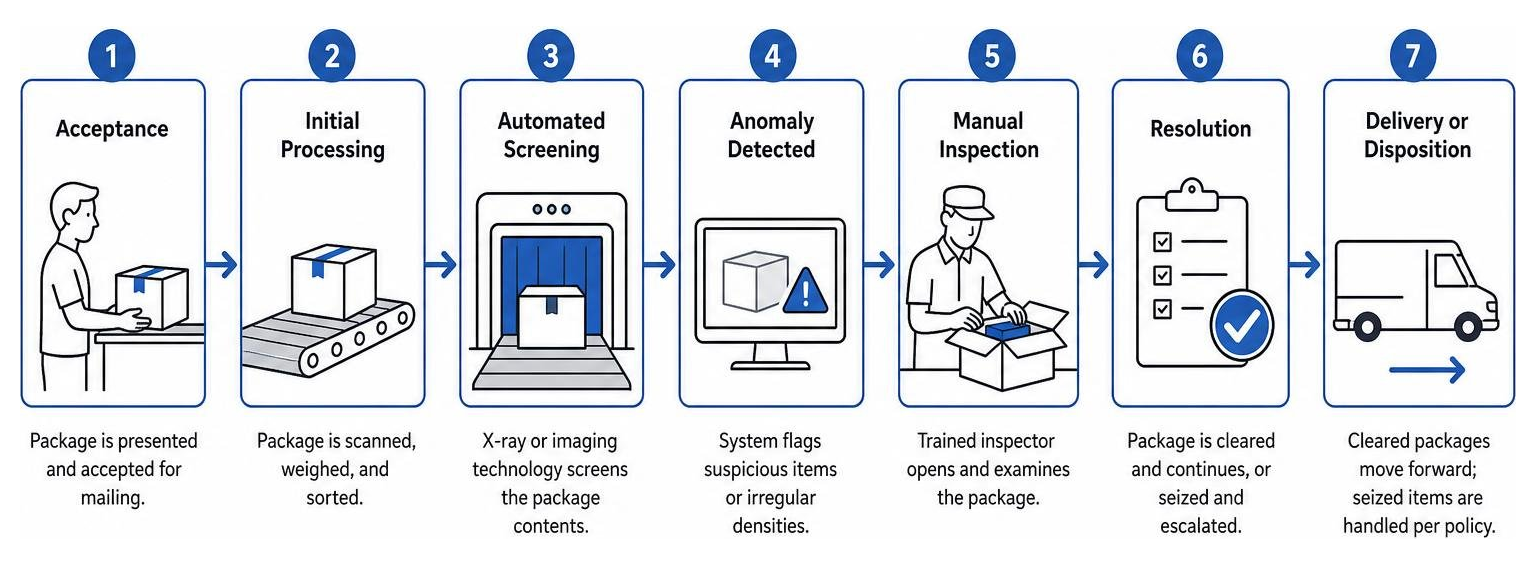
Postal inspectors are trained to spot packages that deviate from normal mailing patterns. The USPS uses advanced, computer-assisted predictive modeling that flags suspicious parcels based on data points before an inspector ever lays eyes on the box.
Some of the most common physical red flags include:
- Excessive Tape: Wrapping a package in layers of duct tape or packing tape in a desperate attempt to seal in odor.
- Fake Return Addresses: Using a non-existent return address or a zip code that does not match the post office of mailing.
- "Do Not X-ray" Markings: Hand-writing warnings on the box, which immediately guarantees the package will be targeted for inspection.
- Perfume Masking: Spraying the box with cologne, air fresheners, or fabric softener. This does not fool drug-detection dogs; it simply alerts human inspectors that someone is trying to hide an odor.
What Happens If a Package Is Seized?
If a carrier or law enforcement officer intercepts a package containing illegal cannabis, the consequences depend heavily on the carrier and the quantity of the product.
With USPS, if a package is deemed suspicious, it is held. If inspectors obtain a warrant and find illegal marijuana, they will initiate an administrative forfeiture of the property. For small, personal-use amounts, the USPS may simply send a formal "letter of seizure" to the return and delivery addresses, stating that the contents have been confiscated. However, they will also log the names and addresses into their database, marking them for future scrutiny.
With private carriers, a flagged package is typically opened immediately. UPS will suspend the shipper's account, while FedEx maintains a strict policy of immediate package destruction. In many cases, the carrier will notify local law enforcement, which can lead to a criminal investigation.
To learn more about how to ensure your deliveries are handled safely and legally without risking seizure, check out our guide on discreet weed delivery.
Controlled Deliveries and Proving Knowing Possession
For larger shipments, law enforcement will not simply send a letter. They may set up a "controlled delivery." This is an undercover operation where a law enforcement officer, disguised as a mail carrier, delivers the intercepted package to the destination address.
To secure a felony conviction, prosecutors must prove "knowing possession"—meaning they must prove you knew what was inside the package and intended to receive it. To build this case, investigators will look at your digital footprint, including:
- Financial Transactions: Venmo, CashApp, or cryptocurrency histories linking you to the sender.
- Communications: Text messages, emails, or encrypted chat logs discussing the shipment.
- Tracking History: Evidence that you repeatedly looked up the package's tracking number on your phone or computer.
What to Do If an Unsolicited Package Arrives
If a package containing cannabis shows up at your door unexpectedly, you must protect your "plausible deniability."
First, do not open it immediately. If law enforcement is monitoring the delivery, opening the package is often used as evidence of knowing possession. Second, do not hide it in a crawlspace or bury it in your backyard. Keep it in a neutral, visible area near your entryway.
Legal experts recommend waiting at least 48 hours before doing anything with an unexpected package. If police knock on your door with a search warrant, your best defense is that you received an unsolicited delivery, had no idea what was inside, and left it by the door intending to return it to the post office.
For a look at how professional, legal delivery services handle discreet drop-offs to keep you safe and clear of any legal gray areas, read our guide on your secret to discreet cannabis.
Frequently Asked Questions about Shipping Cannabis
Can you ship cannabis edibles, vapes, or oils?
The rules differ drastically based on the form of the product:
- Edibles: Hemp-derived CBD or low-THC gummies are legal to ship under the 2018 Farm Bill (though this will change after the November 12, 2026 cliff). Marijuana edibles purchased from a state-licensed dispensary remain federally illegal to ship.
- Vapes: Direct-to-consumer shipping of any vape cartridges—whether they contain nicotine, CBD, or THC—is banned for consumers under the PACT Act.
- Oils: Hemp-derived CBD oils can be shipped legally, but they must be packaged in leak-proof containers, sealed in plastic bags, and accompanied by proper lab documentation.
If you are looking for fast, legal, and compliant ways to get your edibles, check out our resources on rapid relief fast shipping options for cannabis edibles and secret sweets how to get your thc edibles delivered discreetly.
How do state laws affect shipping legal hemp products?
Even though hemp is federally legal, individual state laws vary wildly. Some states have explicitly banned certain hemp-derived cannabinoids.
For example, Idaho Code §37-2701(t) defines marijuana to include any cannabis product containing any quantity of THC. This means shipping even a trace amount of hemp-derived THC into Idaho is treated as a state-level drug crime. Iowa has similarly strict total THC bans. If you are shipping legal hemp, you must ensure the product is legal in the destination state.
To learn more about state-by-state shipping rules and how to get your products quickly, read our guide on fast shipping cannabis.
What documentation is required to ship hemp-derived CBD?
To legally ship hemp-derived products via USPS, you should include the following documentation inside the package to prevent seizure if it is inspected:
- Certificate of Analysis (COA): A laboratory report showing that the product contains 0.3% or less Delta-9 THC on a dry-weight basis.
- Grower Licenses: A copy of the industrial hemp grower license from the state department of agriculture where the hemp was cultivated.
- Self-Certification Statement: A signed statement on the shipper's letterhead certifying that the contents are compliant with the 2018 Farm Bill and USPS Publication 52.
Under USPS rules, mailers must retain these compliance records for at least two to three years after the date of mailing.
Conclusion
The reality of how to ship weed is that doing it yourself is a legal minefield. Between federal felony charges, aggressive private carrier seizure policies, and the upcoming November 12, 2026 hemp redefinition cliff, the risks of mailing cannabis far outweigh the rewards.
At Zaleaf, we take the stress, confusion, and risk completely out of the equation. We offer 100% legal cannabis products delivered straight to your door with incredibly fast shipping and highly discrete packaging. We specialize in enhancing specific cannabinoid and terpene profiles to deliver custom, mood-specific effects—whether you are looking to relax, focus, or find relief.
Every single product we sell undergoes rigorous 3rd-party laboratory testing, and because we operate fully within federal compliance frameworks, no ID or medical card is required to order.
Skip the legal risks of DIY shipping. Let us handle the logistics safely and professionally. Explore our legal online options by reading about our instant gratification top services for fast reliable cannabis delivery, or check out our complete discreet cannabis shipping your worry-free guide to private deliveries to place your order today!