

The ABCs of THC from Delta 8 to 11
The THC Family Is Growing — Here's What You Need to Know About Delta 11
Delta 11 is a rare, hemp-derived cannabinoid that belongs to the same THC family as Delta 8, Delta 9, and Delta 10 — but with a distinct chemical structure and a reputation for notably strong effects.
Here's a quick snapshot of the THC variants covered in this guide:
| Cannabinoid | Potency vs. Delta 9 | Primary Effects | Legal Status (Federal) |
|---|---|---|---|
| Delta 8 | ~50% | Mild, relaxing, clear-headed | Legal (hemp-derived) |
| Delta 9 | Baseline | Euphoric, intense | Federally controlled |
| Delta 10 | ~50% | Uplifting, energizing | Legal (hemp-derived) |
| Delta 11 | Up to 3x stronger* | Euphoric, deeply relaxing | Legal (hemp-derived) |
*Based on user reports and limited research. Scientific evidence is still emerging.
Since the 2018 Farm Bill opened the door for hemp-derived cannabinoids, the cannabis market has exploded with new options. Delta 8 became a household name. Delta 10 followed. Now, Delta 11 is quietly making its way onto shelves — and into conversations among people who want a legal, potent alternative to traditional marijuana.
But with so many "Delta" labels out there, it's easy to get confused. What actually makes Delta 11 different? Is it really stronger? Is it safe? And is it the same as 11-Hydroxy-THC?
This guide answers all of that — clearly and without the hype.
I'm Max Shemesh, owner and CEO of Zaleaf, and I've spent years navigating the hemp and cannabinoid industry to bring customers the highest-quality Delta 11 and other legal cannabinoid products. My hands-on experience sourcing, formulating, and scaling cannabinoid products gives me a grounded, practical perspective on what Delta 11 actually delivers — beyond the marketing claims.
Delta 11 helpful reading:
Understanding the Isomers: Delta 8, 9, and 10
To understand delta 11, we first have to look at its siblings. In organic chemistry, these compounds are called "isomers." This means they all share the exact same chemical formula (C21H30O2) but have a different arrangement of atoms. Think of them like Lego sets: you have the same 50 bricks, but in one set you build a car (Delta 9), and in another, you build a plane (Delta 8).
The "Delta" number refers specifically to where a double bond is located on the carbon chain.
- Delta 9 THC has its double bond on the 9th carbon atom. This is the "traditional" THC found in high concentrations in marijuana.
- Delta 8 THC has that bond on the 8th carbon.
- Delta 10 THC has it on the 10th.
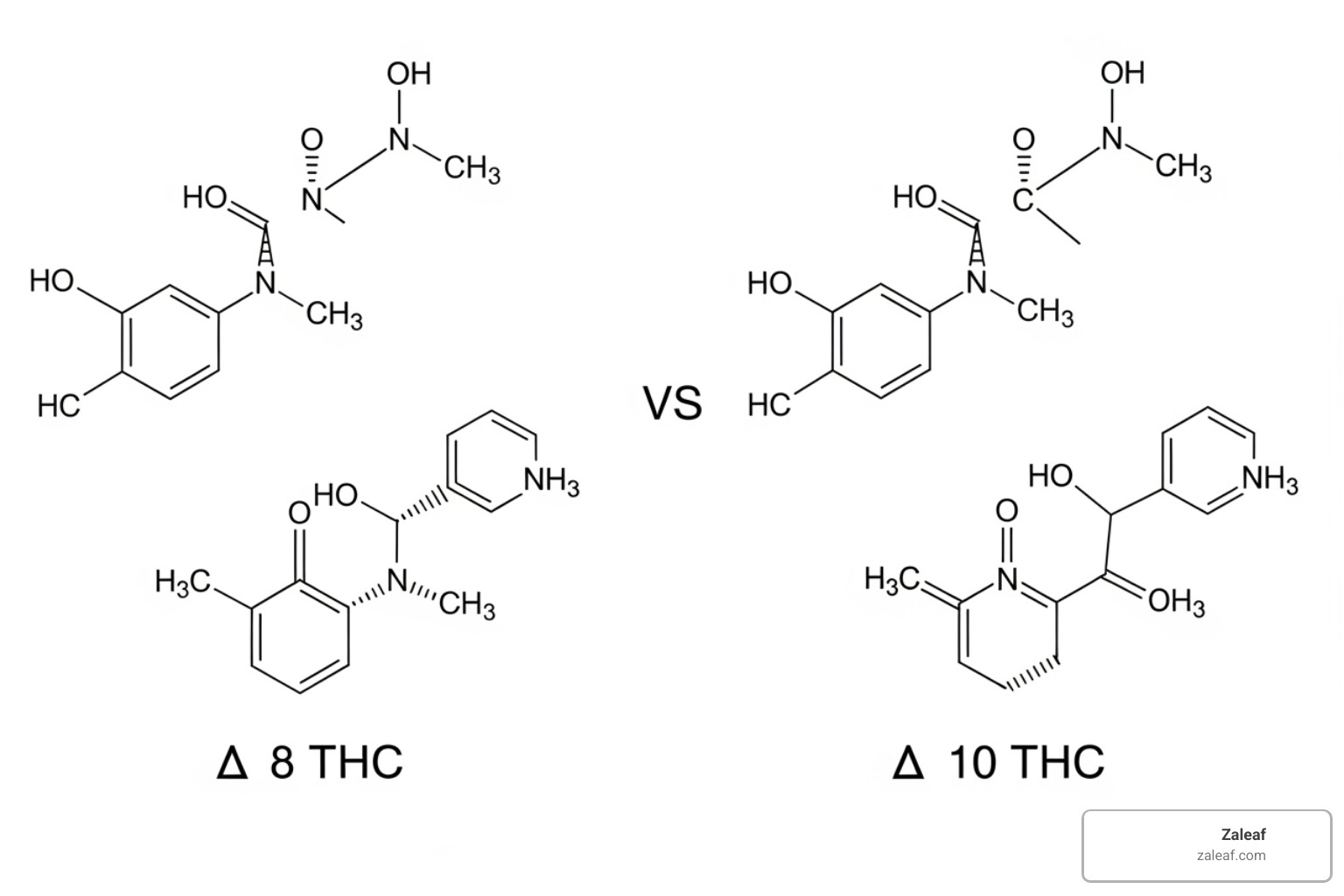
While it might seem like a small shift, Understanding Delta 8 and its structure helps explain why it feels different. Because the bond is in a different spot, it connects with your body’s endocannabinoid system (ECS) differently. This results in varying levels of psychoactive potency.
Delta 8 and Delta 10 Characteristics
Most users find that these isomers offer a "THC-lite" experience. When looking at Delta 8 vs CBD, the biggest difference is that CBD is non-intoxicating, while Delta 8 provides a mellow, functional high. It’s often described as clear-headed and less likely to induce the "couch-lock" or anxiety sometimes associated with Delta 9.
Delta 10 is even more specialized. It’s frequently celebrated for its energizing and uplifting vibes, making it a popular choice for daytime use, focus, and creativity. According to the Pharmacology of isomers, these variations in the double bond position change how the molecule fits into the CB1 receptors in your brain, which is why Delta 8 and 10 are generally considered about half as potent as Delta 9.
What is Delta 11 THC?
Now we get to the newcomer: delta 11 (also known as Δ11-THC or Δ9(11)-THC). As you might have guessed by now, the name comes from the fact that the double bond is located on the 11th carbon atom.
Delta 11 is a naturally occurring minor cannabinoid found in trace amounts in both hemp and cannabis plants. However, because it exists in such tiny quantities, it is almost never extracted directly from the plant for commercial use. Instead, chemists use specialized processes to convert more abundant cannabinoids like CBD into delta 11.
This conversion process typically involves taking CBD isolate and applying specific heat catalysts or chemical reagents to rearrange those carbon bonds. This isn't "synthetic" in the way a lab-made chemical is; it's a structural rearrangement of a natural hemp molecule. You can find the technical Chemical structure details in scientific databases, which confirm its identity as a distinct isomer. The Synthesis of Delta 11 has been documented in organic chemistry journals as far back as the early 1970s, though it has only recently become a consumer product.
The Potency and Effects of Delta 11
This is where things get exciting—and a little mysterious. While Delta 8 and 10 are known for being milder than traditional THC, delta 11 is gaining a reputation for psychoactive intensity.
Many user anecdotes suggest that delta 11 provides a powerful cerebral high and deep full-body relaxation. Some consumers even claim it is up to three times stronger than Delta 9 THC. Why would this be? Some researchers believe the 11th carbon bond allows the molecule to bind more "tightly" or efficiently to the CB1 receptors in the brain.
In fact, Binding affinity research suggests that certain minor cannabinoids and their by-products can significantly modulate receptor activity. While we still need more human clinical trials, the early feedback from the community is that delta 11 is not for the faint of heart. It offers a fast-acting "rush" followed by a heavy, euphoric state that many find more relaxing than Delta 8.
Delta 11 vs. 11-Hydroxy-THC
We need to clear up a major point of confusion. If you search for "delta 11," you will often see results for "11-Hydroxy-THC." These are not the same thing.
- Delta 11 THC is a cannabinoid found in the plant (or converted from CBD). It is an isomer.
- 11-Hydroxy-THC (11-OH-THC) is a metabolite. It is what your liver creates after you ingest Delta 9 THC (usually via an edible).
When you eat a weed brownie, your liver processes the Delta 9 and turns it into 11-Hydroxy-THC, which is famous for being much more potent and long-lasting than inhaled THC. Because the names are so similar, many people (and even some less-than-reputable sellers) confuse the two.
According to 11-OH-THC pharmacokinetics, the liver's enzyme hydroxylation process is what makes edibles feel so "different." While delta 11 might share some of that heavy potency, it is a distinct molecule that you can vape or smoke, whereas 11-Hydroxy-THC is something your body makes internally.
Legality and Safety of Hemp-Derived Cannabinoids
One of the biggest questions we get at Zaleaf is: "Is this actually legal?"
The short answer is yes, at the federal level. The 2018 Farm Bill (officially the H.R.2 Agriculture Improvement Act) legalized hemp and all of its derivatives, isomers, and cannabinoids, provided the final product contains less than 0.3% Delta 9 THC by dry weight.
Since delta 11 is an isomer derived from hemp and is not Delta 9, it fits into this legal framework. However, the Legal landscape of Delta 8 and other isomers is constantly shifting. Some states have moved to ban or restrict these "alternative" THCs. Currently, about 17 to 20 states have some form of restriction on hemp-derived psychoactive isomers, so we always recommend checking your local laws before ordering.
Safety is our top priority. Because the FDA does not currently regulate these products, the responsibility falls on brands like us to ensure quality. At Zaleaf, we specialize in enhancing cannabinoid and terpene profiles for mood-specific effects, and we never skip the most important step: third-party testing.
Drug Testing and Precautions
If you have a drug test coming up for work or sports, pay close attention: Delta 11 will likely cause you to fail.
Standard drug tests are not actually looking for the "Delta 9" molecule itself. Instead, they look for a metabolite called THC-COOH. Because delta 11 is so chemically similar to Delta 9, your body processes it into very similar metabolites.
According to Drug testing procedures, these tests are designed to be sensitive. Even though you are using a legal hemp product, the test can't tell the difference between legal delta 11 and illegal marijuana. We always suggest avoiding all THC variants for at least 30 days if you anticipate a screening.
Always look for a Certificate of Analysis (COA) when you buy. A COA is a document from an independent lab that proves the product contains what the label says and is free from heavy metals, pesticides, and residual solvents. If a company won't show you their lab reports, don't buy from them!
Frequently Asked Questions about Delta 11
Is Delta 11 stronger than Delta 9?
Based on user feedback, many people report that delta 11 feels significantly stronger than Delta 9—with some claims suggesting it is 3x more potent. However, scientific Comparative pharmacology is still limited. One older study on rhesus monkeys and mice suggested it might actually be less potent in certain biological contexts, but humans report a very intense "head buzz" and euphoric rush. Potency often comes down to individual body chemistry and the "entourage effect" (how the THC interacts with other terpenes and cannabinoids in the product).
How is Delta 11 produced?
Because it's a minor cannabinoid, it's produced through lab synthesis—specifically, a process called "isomerization." Chemists start with CBD isolate (extracted from legal hemp) and use heat and organic catalysts to break and reform the chemical bonds until the molecule transforms into delta 11. This allows for industrial scaling so we can offer these products at an affordable price.
Does Delta 11 show up on a drug test?
Yes. As mentioned earlier, the Metabolism of cannabinoids results in the production of THC-COOH, which is the primary marker for drug panels. Whether you're vaping Delta 8, 9, 10, or 11, the "cross-reactivity" on a standard urine or blood test is extremely high.
Conclusion
The world of cannabinoids is moving fast, and delta 11 is the latest proof that there is always more to discover within the hemp plant. Whether you’re looking for the mild, functional chill of Delta 8 or the intense, euphoric relaxation reported with delta 11, the key is to choose products you can trust.
At Zaleaf, we take the guesswork out of the equation. We offer 100% legal cannabis products with fast shipping and discrete packaging delivered right to your door. We focus on high-end formulations that maximize the benefits of the plant, and every single batch undergoes rigorous 3rd party testing to ensure your safety and satisfaction. No ID or medical card is required to start your journey.
Ready to experience the next level of hemp? Shop all legal cannabis products at Zaleaf today and find the perfect vibe for your lifestyle.