

Clearing the Air: How Long Does Vaped THC Stick Around?
Understanding THC Detection: What You Need to Know
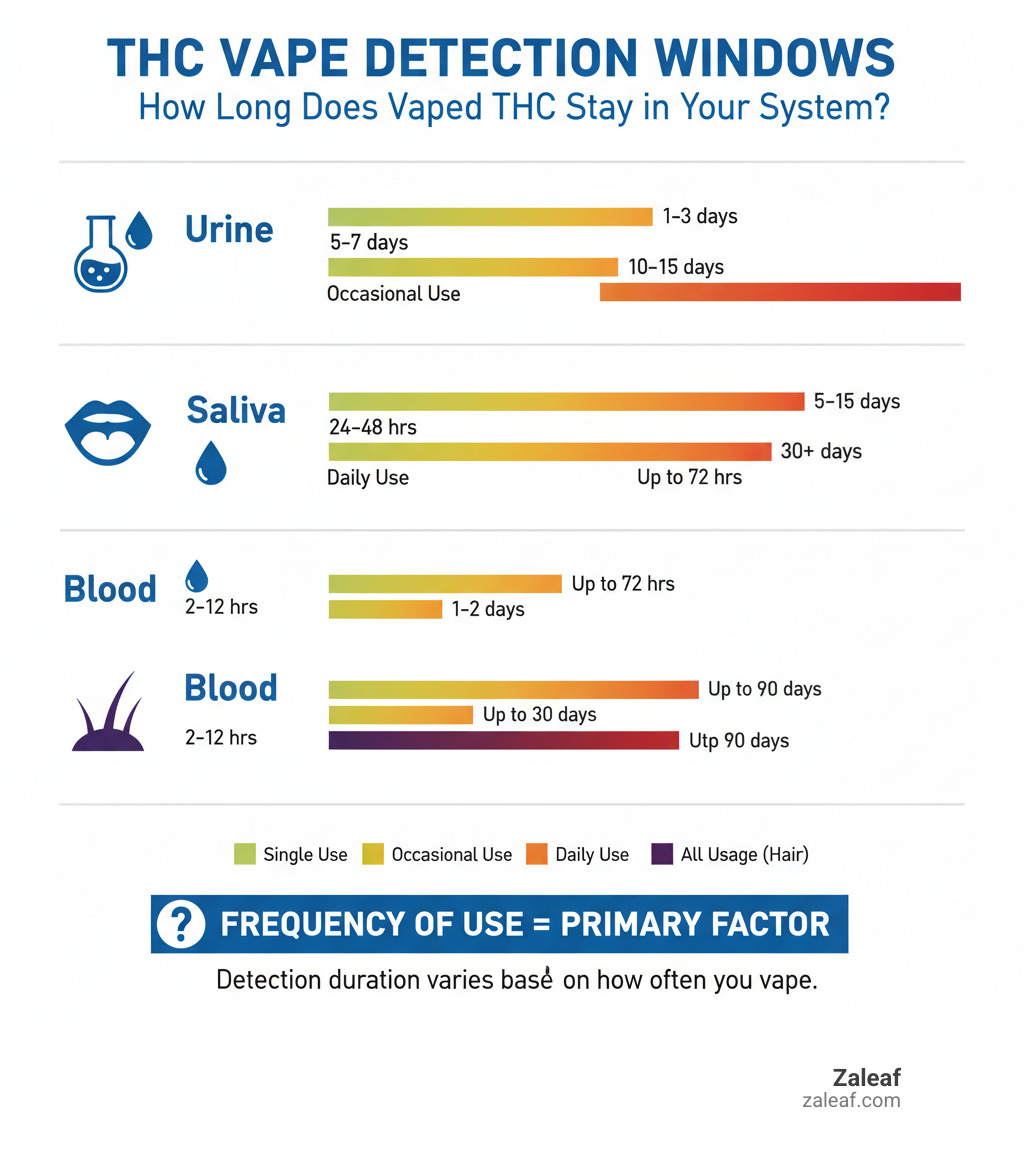
How long does THC vape stay in your system is a common question for cannabis users facing drug tests. The answer isn't simple, as detection times vary based on usage, body composition, and test type.
Quick Answer: THC Vape Detection Windows
| Test Type | Single Use | Occasional Use | Daily Use | Chronic Use |
|---|---|---|---|---|
| Urine | 1-3 days | 5-7 days | 10-15 days | 30+ days |
| Saliva | 24-48 hours | 24-48 hours | Up to 72 hours | Up to 72 hours |
| Blood | 2-12 hours | 1-2 days | 2-7 days | Up to 30 days |
| Hair | Up to 90 days | Up to 90 days | Up to 90 days | Up to 90 days |
These timelines are based on how your body processes THC. When you vape, THC enters your bloodstream, is metabolized by the liver into compounds like THC-COOH, and then stored in fat cells. Since THC is fat-soluble, it can linger, especially for regular users.
Online discussions on how long does THC vape stay in your system confirm there's no single answer. A single session might clear in days, but daily use can lead to a positive test for a month or more.
I'm Max Shemesh, Owner & CEO of Zaleaf. I've spent years helping customers understand cannabinoids and their effects, including the critical question of how long does THC vape stay in your system. At Zaleaf, our commitment to transparency and third-party testing helps consumers make informed decisions.
This guide covers THC metabolism, factors influencing detection times, and how to manage your risk for a drug test.
The Science of THC Metabolism: From Vape to Test
When you vape THC, it begins a complex journey in your body. Understanding this process helps explain how long does THC vape stay in your system.
Here's how THC moves through your system:
Rapid Absorption: Vaped THC enters your lungs and quickly passes into the bloodstream, which is why the effects are felt so fast.
Liver Processing: THC travels to the liver, where enzymes break down active delta-9-THC into metabolites. The main metabolite drug tests look for is THC-COOH. The liver converts THC into these compounds for elimination. For a deeper dive, see this explanation of THC metabolites explained.
Fat-Solubility and Storage: THC and its metabolites are lipophilic (fat-soluble), meaning they bind to fat cells. This storage is why THC lingers longer than many other substances. Regular use leads to accumulation in fat cells, extending the time it takes to clear your system.
Elimination Process: Stored THC compounds are slowly released from fat cells and eliminated, primarily through stool (about 65%) and urine (about 20%). This slow release extends detection times, sometimes for weeks or months.
Half-Life Concept: A drug's half-life is the time it takes for half of it to be eliminated. THC's half-life varies with use. For an infrequent user, it can be as short as 1.3 days. For regular users, it can be between 5-13 days.
Time to Full Elimination: It takes about 5.5 half-lives for a drug to be fully eliminated. For a regular user with a 5-13 day half-life, this explains why it can take so long to clear THC, a common story found in online forums.
Factors That Influence THC Detection Times

Online threads asking how long does THC vape stay in your system show varied answers because detection isn't one-size-fits-all. Your unique body and many factors affect how long THC stays in your system. How long THC lingers depends on your personal habits and biology.
Frequency and Dosage
This is the biggest factor. How often you vape makes a huge difference.
- Single-use vapers can clear THC metabolites in a few days.
- Occasional users (a few times a week) will find metabolites accumulate, pushing the detection window to a week or more.
- Daily users constantly process new THC, extending detection times to two weeks or longer.
- Chronic, heavy users face the longest detection windows, sometimes 30+ days for urine tests, as fat cells slowly release stored metabolites.
Potency also matters. Vape concentrates (50-90% THC) are much stronger than flower (15-30% THC). Higher potency means more metabolites for your body to eliminate.
Body Composition and Metabolism
Your body's chemistry is just as important as your habits.
- Body fat percentage is crucial. Since THC is fat-soluble, a higher BMI means more storage for metabolites, which are released gradually, extending detection time.
- A faster metabolic rate clears THC more quickly. Metabolism often slows with age, so THC may linger longer.
- Genetics affect liver enzymes that break down THC, meaning some people naturally clear it faster than others.
- Your overall health, particularly liver and kidney function, is important. These organs are key to detox, and poor function slows elimination. Good health supports your body's natural processes.
Navigating this can be overwhelming, which we explore in Vaping and Drug Tests: The THC Pen Dilemma. The answer to how long does THC vape stay in your system is: it depends on you.
How Long Does THC Vape Stay in Your System: Detection Windows by Test Type
To figure out how long does THC vape stay in your system, you must know the test type. Each method has a unique detection window. Here are the most common tests.
Urine Tests: The Most Common Hurdle
Urine tests are the most common, used by employers because they are affordable and have a good detection range. They detect the inactive metabolite THC-COOH, not active THC.
Detection windows vary by use: single use (1-3 days), occasional use (5-7 days), daily use (10-15 days), and chronic, heavy use (30+ days). Most tests use a 50 ng/mL cutoff. This is supported by research on urine test detection windows.
Saliva Tests: Detecting Recent Use
Saliva tests are common for roadside checks as they detect recent use. They detect active THC (delta-9-THC), indicating use in the last few hours or days. Detection is 24-48 hours for a single use and up to 72 hours for a frequent user.
Research confirms saliva tests are effective for detecting same-day use, and can detect THC in frequent smokers up to 72 hours after use.
Blood Tests: A Snapshot in Time
Blood tests are not routine but are used to check for recent impairment, such as in DUI investigations. They detect both active THC (delta-9-THC) and its metabolites. For infrequent users, active THC is detectable for 2-12 hours. For frequent users, metabolites can be detected up to 30 days after use. The short window for active THC is key for impairment cases.
Hair Follicle Tests: The 90-Day Lookback
Hair follicle tests have the longest detection window, revealing use from months ago. Hair tests find THC metabolites trapped in the hair shaft as it grows. They can detect use up to 90 days prior. Testers use a 1.5-inch hair segment to analyze the past three months of use.
These tests don't catch recent use, as it takes 7-10 days for metabolites to grow into the hair.
Vapes, Edibles, and Flower: How Consumption Method Matters
In online discussions about how long does THC vape stay in your system, users debate if consumption method matters. It does, but perhaps not how you think.
Vaping vs. Edibles
When you vape, THC is absorbed rapidly through the lungs, so effects are fast. For occasional users, elimination can also be swift. However, vapes are often highly concentrated, leading to higher THC consumption.
Edibles are different. They are processed through the digestive system, where the liver converts delta-9-THC into 11-hydroxy-THC, a more potent and longer-lasting metabolite. This is why edibles may stay in your system longer, with slower onset and a longer detection window.
Does the Type of Vape Product Matter?
Does vaping wax versus oil or live resin affect detection times? Not really.
The key factor is the total THC concentration, not the type of concentrate. Concentrates (50-90% THC) are much stronger than flower (15-30%), so even a small amount delivers a lot of THC.
Your body metabolizes THC the same regardless of the concentrate type. The determining factors are the amount and frequency of use. A hit of high-potency concentrate delivers more THC than a puff of flower, creating more metabolites to store.
Drug tests detect THC's presence, not its consumption method. Your detection window depends on your usage and total THC load. We explore this in THC Vape Pens and Drug Dogs: What You Need to Know. Understanding your consumption and how your body processes it is key to making informed decisions.
The "Other" Cannabinoids: Delta-8, Delta-10, and CBD Vapes
Beyond traditional Delta-9 THC, cannabinoids like Delta-8, Delta-10, and CBD are popular. Users often ask how long does THC vape stay in your system for these alternatives. Here's what to expect.
Will Delta-8 or Delta-10 Vapes Make You Fail a Drug Test?
Yes, using Delta-8 or Delta-10 vapes will likely cause you to fail a drug test. Here's why:
- Chemical Similarities: Delta-8 and Delta-10 are chemically similar to Delta-9 THC. Your body creates metabolites that are nearly identical to those from Delta-9.
- Lack of Test Specificity: Standard drug tests look for a general THC metabolite signature and can't distinguish between Delta-8 and Delta-9 THC, leading to a positive result.
- Potential Impurities: The conversion process to create Delta-8 and Delta-10 can leave trace amounts of Delta-9 THC, which can trigger a positive test.
- User Experiences: Online forums are full of stories from users who failed drug tests after using Delta-8 or Delta-10 products.
If you face a drug test, avoid Delta-8 and Delta-10 products. Learn more in our guide: Will Delta 8 Show Up? Your Guide to D8 and Drug Screening.
Can CBD Vapes Cause a Positive THC Test?
This is nuanced: it's possible, especially with regular use of full-spectrum CBD products.
- CBD Isolate: The purest form of CBD with all THC removed. High-quality isolate products pose virtually no risk of a positive test and are the safest option.
- Full-Spectrum CBD: These products contain all plant compounds, including trace amounts of THC (up to the 0.3% legal limit). This amount is non-psychoactive but not zero.
The main concern is trace THC accumulation. With frequent, high-dose use, these small amounts of THC can build up in fat cells and potentially lead to a positive test. A 2021 case report showed that daily use of a CBD-rich joint with only 0.2% delta-9 THC led to detectable THC metabolites in urine after just 8 days, proving that even low, consistent levels can accumulate.
This highlights the importance of lab testing. At Zaleaf, all our products undergo rigorous 3rd-party testing. We provide Certificates of Analysis (CoAs) for transparency, allowing you to verify cannabinoid content and THC levels for peace of mind. If passing a drug test is crucial, choose CBD isolate products with verifiable lab results.
Can You Speed Up THC Elimination? Myths vs. Reality
With a drug test looming, many search for shortcuts in online discussions about how long does THC vape stay in your system. The stakes are high, but quick fixes are often myths. Most online "quick fix" methods are ineffective or even harmful. Let's separate myth from reality.
Debunking Detox Myths: What Doesn't Work
You'll find many detox kits and drinks promising to cleanse your system in hours, but the science doesn't support these claims. These products often just dilute your urine temporarily. They don't eliminate the THC metabolites stored in your fat cells. Labs can detect dilution, which may lead to a retest.
The niacin myth is another popular but unproven claim. Megadoses of niacin won't flush THC and can cause side effects, including liver damage. Cranberry juice supports urinary health but doesn't eliminate THC any better than water.
Drinking excessive water right before a test to dilute urine is risky. Samples can be flagged as invalid, requiring a retest. It only masks THC, it doesn't remove it. These methods are unreliable and don't address the core issue of THC stored in fat cells.
What Might Help (and What's a Fact) for How Long THC Stays in Your System
So what works? The answer is simple: time and a healthy lifestyle.
The most effective method is to stop consuming THC immediately. This allows your body to start eliminating stored metabolites. For anyone asking how long does THC vape stay in your system, abstinence is the only guaranteed solution.
Proper hydration supports your kidneys' natural filtering process. Drink water normally, don't overdo it before a test. A healthy, high-fiber diet aids elimination, as about 65% of metabolites are excreted through stool. Good nutrition also supports liver and kidney function.
Exercise can be complicated. Regular cardio helps burn fat, speeding up long-term elimination. However, avoid intense exercise 24-48 hours before a test. Burning fat releases stored THC metabolites, which can temporarily spike levels in your urine.
There is no magic solution. The only reliable way to pass a drug test is to give your body time to clear THC naturally, supported by a healthy lifestyle. Shortcuts are not dependable.
Legal & Employment Landscape: What a Positive Test Means
Beyond the science of how long does THC vape stay in your system, a positive test has real-world consequences. Despite growing legalization, the legal and employment landscape for cannabis is complex and can impact your job.
Navigating Workplace Drug Policies
- State vs. Federal Law: Though legal in many states, marijuana remains a federal Schedule I drug under the Controlled Substances Act. Federal law often overrides state law for employers.
- Employer Discretion: Even in legal states, employers can maintain a drug-free workplace. They can test for THC and take disciplinary action, including termination, for a positive result. Not all legal states have employee protection laws.
- At-Will Employment: Most U.S. employment is "at-will," meaning an employer can terminate you for nearly any non-discriminatory reason, including a positive THC test.
- Safety-Sensitive Jobs: For roles in transportation, healthcare, or operating heavy machinery, drug testing is often federally mandated and strict. A positive test can lead to immediate job loss and future career difficulties, a topic we touch on in Can You Fly with THC Gummies in 2025? Navigating TSA Rules.
Understanding Your Rights
While employers have broad rights, some protections are emerging.
- State-Specific Protections: Some states are introducing laws to protect off-duty cannabis use, particularly for medical patients in non-safety-sensitive jobs. These laws vary widely and are constantly changing.
- Medical Marijuana Laws: Some states offer limited employment protections for medical patients, but these are not universal and often exclude safety-sensitive roles or federal contractors.
- Know Your Local Regulations: Stay informed about your state and local laws on cannabis use and employment. Check with state labor departments for information.
The safest approach is to abstain from THC long enough to pass a test. This protects your employment and reduces anxiety about how how long THC vape stays in your system could impact your career.
Conclusion: Clearing the Air on THC Detection
Many people anxiously search online for answers to how long does THC vape stay in your system. While forums offer support, the science of THC detection is personal and complex.
As we've covered, detection is highly individual. Factors like body composition, metabolism, and genetics mean your timeline will be unique. The biggest factor is frequency of use. A single session clears in days, while chronic use can take a month or more. Test type also matters: saliva tests detect recent use (24-72 hours), while hair tests look back 90 days.
"Alternative" cannabinoids like Delta-8 and Delta-10 will likely cause a positive test. Even full-spectrum CBD carries a small risk with frequent use. Detox kits are unreliable; the only sure method is abstinence and time.
At Zaleaf, we're committed to transparency for informed consumption. All our 100% legal cannabis products have rigorous 3rd-party testing, so you know exactly what you're getting. We provide honest information and quality products to help you steer this complex landscape.
Understanding how long does THC vape stay in your system is about more than passing a test. It's about understanding your body and making choices that fit your circumstances. Knowledge is your best tool.
For more details, see our guide: From Puff to Test: Understanding How Long THC Vape Pens Stay in Your System. Understanding the science and giving your body time is the best path forward.