

Quality Assured: What 'Certified CBD Vape' Really Means
Why Quality Matters When Choosing a CBD Vape
Certified CBD vape products stand out in a crowded market by meeting rigorous safety and quality standards. Here's what to look for when identifying quality products:
Key Quality Indicators:
- Third-party lab testing with publicly available Certificates of Analysis (COA)
- Clear ingredient lists showing CBD concentration, THC levels (<0.3%), and carrier liquids
- Clean formulations free from Vitamin E Acetate, MCT oil, and harmful additives
- Proper labeling with cannabinoid profiles, terpene content, and batch numbers
- Transparent sourcing from organic, US-grown hemp
With CBD vapes flooding gas stations, online stores, and dispensaries, knowing what separates a safe, effective product from a potentially dangerous one has never been more important. The lack of strict FDA regulation means consumers must become their own quality inspectors. Research shows that many CBD products contain significantly different cannabinoid levels than advertised, while some harbor dangerous contaminants like heavy metals, pesticides, or harmful cutting agents.
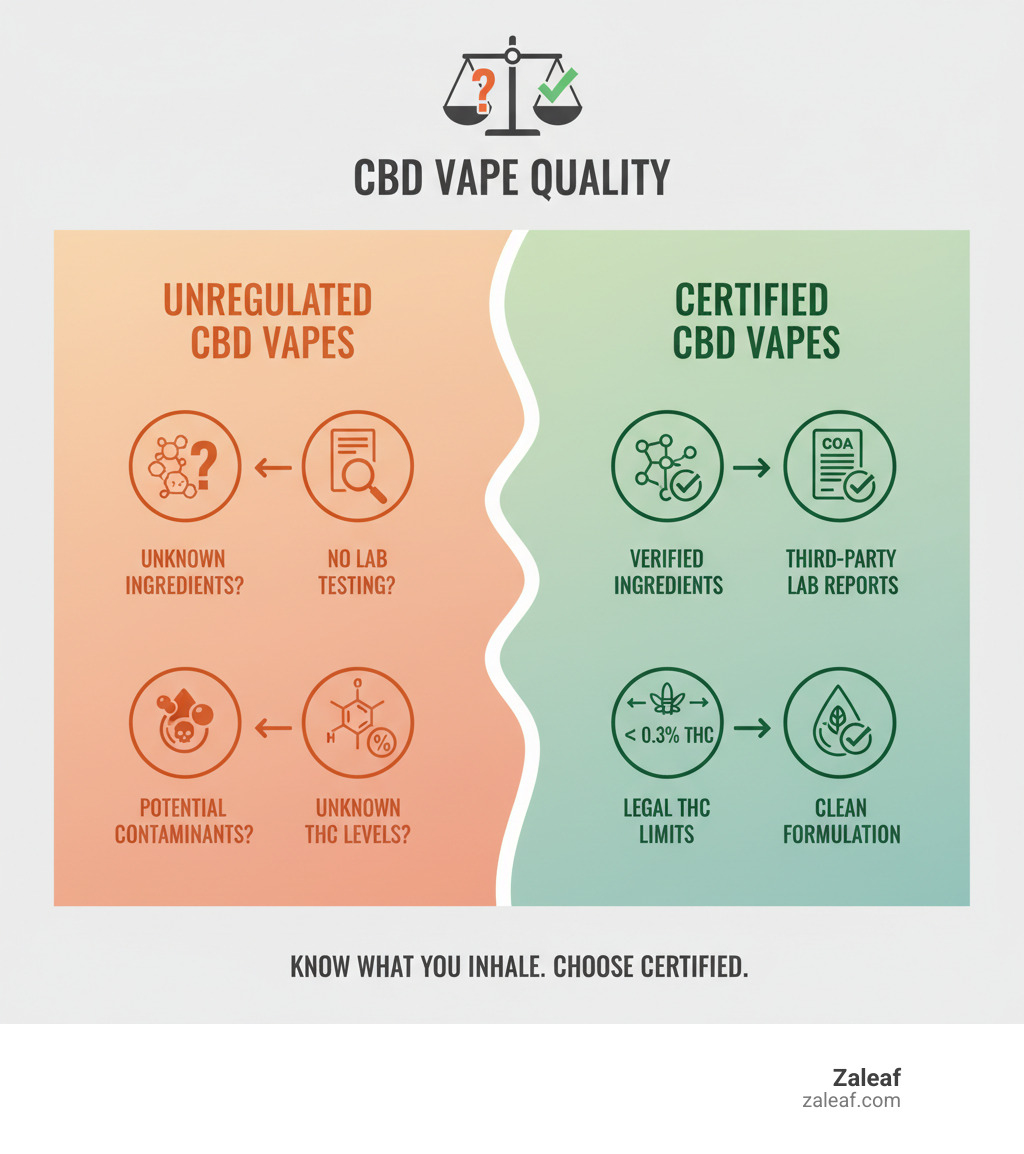
The good news? Certified CBD vape products undergo independent laboratory testing to verify purity, potency, and safety. These tests screen for everything from accurate CBD content to the absence of toxins, giving you peace of mind with every puff. Unlike unregulated products, certified vapes provide transparent lab reports that prove exactly what you're inhaling.
As Max Shemesh, Owner & CEO of Zaleaf, I've spent years building partnerships with over 300 retailers by prioritizing third-party testing and transparent quality standards for every certified CBD vape we produce. This guide will help you understand what certification truly means and how to spot products worth your trust.
Decoding the 'Certified CBD vape': The Role of Third-Party Lab Testing
When you see the term certified CBD vape, you're really looking at products that have passed through rigorous third-party lab testing. This isn't marketing fluff—it's the foundation of trust in an industry where the FDA doesn't regularly inspect every product hitting the shelves.
Here's how it works: manufacturers send their CBD vape products to independent, accredited laboratories that have no financial stake in the results. These labs run comprehensive tests and issue a Certificate of Analysis, or COA. Think of it as your product's report card, showing exactly what's inside that vape pen you're about to use.
What these labs actually test for matters more than you might think. They measure cannabinoid potency to verify you're getting the CBD levels advertised on the label, plus they check for other cannabinoids like CBG, CBN, and especially THC. They analyze the terpene profile to confirm those aromatic compounds that contribute to flavor and the "entourage effect" are actually present.
But the most critical part? Contaminant screening. Hemp plants are bio-accumulators, meaning they absorb everything from the soil they grow in—the good and the bad. Labs screen for heavy metals like lead and mercury, pesticides from farming, and residual solvents from extraction processes. They also check for mold, mildew, and bacteria that could make you sick.
As cannabis specialists from Harvard Medical School point out, many CBD products "inadvertently contain heavy metals and pesticides which are bad for you, and some of them contain nasty chemicals." This is exactly why choosing a certified CBD vape with proper testing isn't optional—it's essential.
The FDA acknowledges CBD's potential benefits but maintains a cautious stance, especially for products marketed as foods or supplements. They've emphasized concerns about untested products and misleading claims, putting the responsibility squarely on consumers to seek out reliable sources. You can learn more about the FDA's stance on CBD regulation to understand the current landscape.
What to Look for in a Lab Report
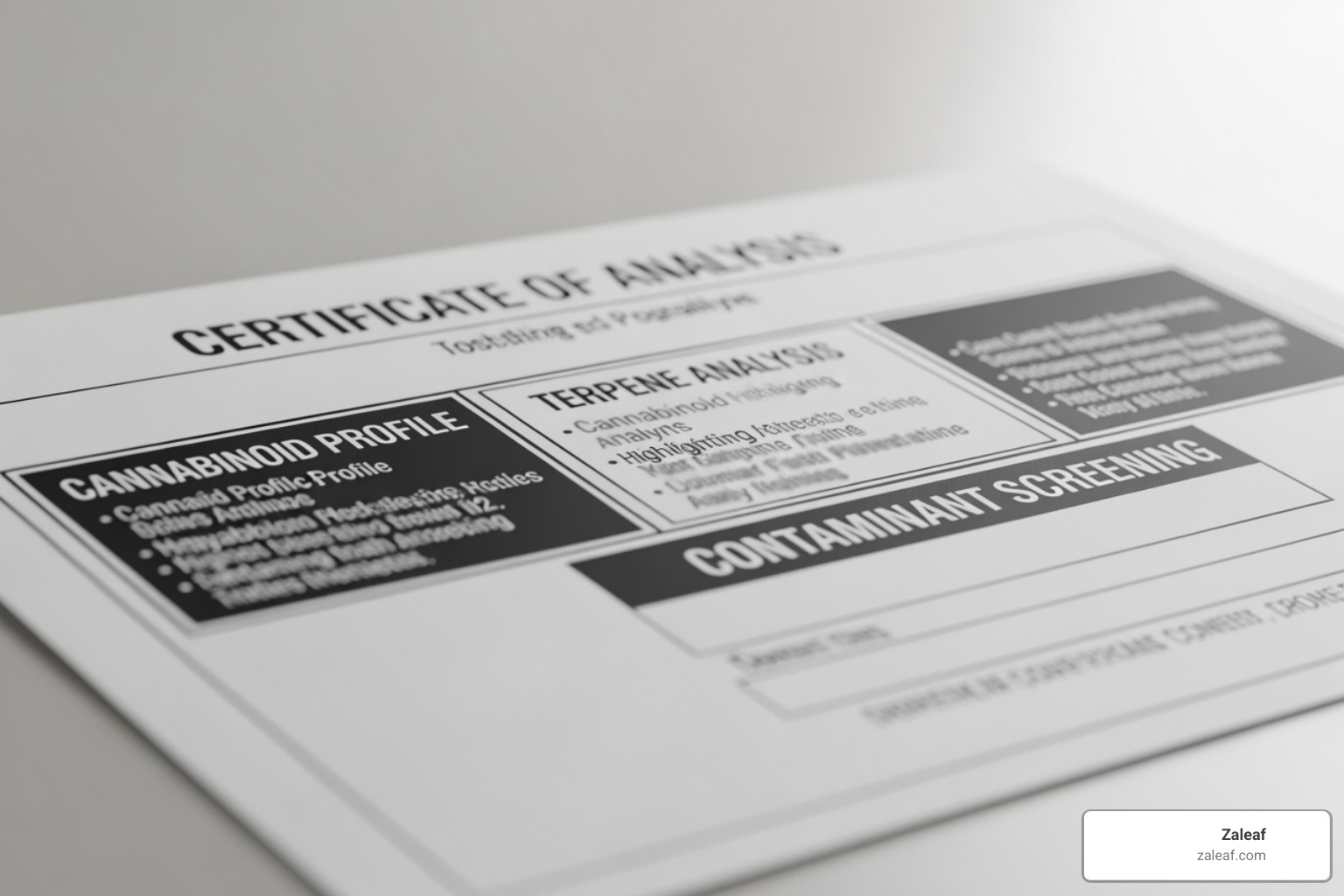
A Certificate of Analysis is your window into what you're actually vaping. When you're reviewing a COA for a certified CBD vape, start with the basics: the CBD concentration should match what's printed on the package. If the label says 500mg, the lab report better confirm it.
Next, check the THC levels. Under the 2018 Farm Bill, legal CBD products must contain less than 0.3% Delta-9 THC. The COA needs to clearly show THC levels below this threshold. If a product claims to be "THC-free," you should see "non-detectable" or "ND" on the report.
A complete cannabinoid profile goes beyond just CBD and THC. Quality reports list other cannabinoids like CBG, CBN, and CBC, giving you the full picture of what's in your vape. This information also confirms whether you're getting a full-spectrum, broad-spectrum, or isolate product.
If the product mentions terpenes or the entourage effect, the terpene analysis section should break down which specific terpenes are present and in what amounts. This tells you about potential flavor and effects.
The contaminant screening results should show clear "Pass" marks for heavy metals, pesticides, residual solvents, and microbial contaminants. Any "Fail" or "Detected" in these categories means you should immediately look for a different product.
Finally, check for lab accreditation. The testing facility should be ISO 17025 accredited, which means they meet international standards for technical competence. This accreditation ensures the test results are reliable and valid.
We make our third-party lab reports easily accessible because transparency isn't just good practice—it's the only way to build real trust with people who use our products.
How to Spot a Fake or Low-Quality Product
The CBD market can feel overwhelming, especially when some manufacturers take advantage of loose regulations to sell questionable products. Knowing what red flags to watch for protects both your wallet and your health.
The biggest warning sign? Missing lab reports. If a company can't or won't provide a recent, comprehensive Certificate of Analysis from an independent third-party lab, don't give them your money. No exceptions. These reports are your only real guarantee of what's in that vape pen.
Vague ingredient lists are another major red flag. Quality products clearly list every ingredient. Generic terms like "cannabis extract" or "natural flavors" without specifics should make you suspicious. Some low-quality vapes hide harmful cutting agents behind vague language, hoping you won't notice.
Watch out for exaggerated health claims too. While CBD offers many potential benefits, legitimate companies don't promise miracle cures. If a product claims to cure serious diseases or fix every health problem imaginable, run the other direction. The science around CBD is promising but still evolving.
A reputable company provides clear contact information—phone number, email, and physical address. If you can't easily find ways to reach the manufacturer, ask yourself why they're hiding.
Pricing that seems too good to be true usually is. Quality CBD products require proper cultivation, extraction, and testing, which costs money. Suspiciously cheap vapes often indicate low-quality ingredients, poor extraction methods, or skipped testing.
Finally, look for transparency about sourcing. Where was the hemp grown? What cultivation practices were used? How was the CBD extracted? Quality companies answer these questions readily because they're proud of their processes.
Understanding Navigating the haze: The legality of CBD vape pens explained gives you additional context about what's legal and what to avoid. Our approach is straightforward: every certified CBD vape we offer is transparently sourced, rigorously tested, and clearly labeled so you never have to guess what you're inhaling.
Understanding Your CBD Vape: Ingredients and Product Types
Choosing a certified CBD vape isn't just about finding any CBD product; it's about understanding the nuances of what you're inhaling and how it's delivered. Think of it like choosing a car – you wouldn't buy one without knowing whether it's electric, hybrid, or gas-powered, right? The same goes for your vape.
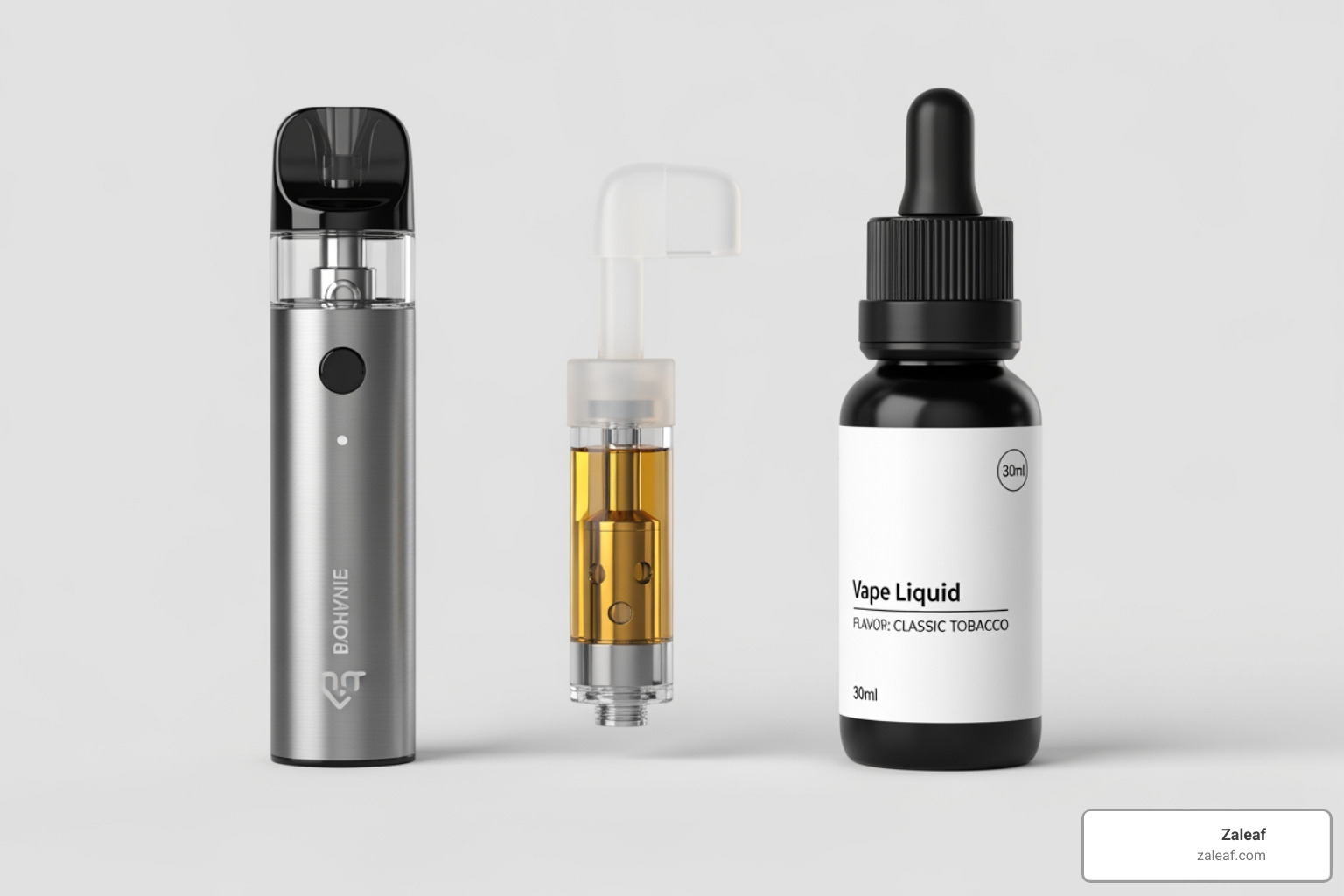
The market offers three main types of CBD vape products, each designed to suit different lifestyles and preferences. CBD e-liquids (also called vape juice) come in bottles and are specifically formulated for refilling compatible devices. If you're someone who vapes regularly and enjoys experimenting with different flavors and concentrations, e-liquids offer a more economical and eco-friendly option in the long run.
Disposable pens are the grab-and-go option of the vaping world. These all-in-one units come pre-filled with CBD vape oil and have a built-in battery that's ready to use right out of the box. They're perfect for beginners who want to dip their toes into CBD vaping without committing to a whole setup, or for occasional vapers who value convenience above all else. Once the liquid runs out or the battery dies, you simply dispose of the entire unit. They're practical, discreet, and deliver smaller, more controlled puffs.
Then there are cartridges (sometimes called pods), which offer a middle ground between disposables and e-liquids. These pre-filled containers attach to a reusable vape battery, often using the industry-standard 510-thread connection. When your cartridge runs empty, you simply swap it out for a fresh one. This gives you the flexibility to try different flavors or CBD formulations while still maintaining some of the convenience of a disposable.
Key Ingredients: The Good and The Bad
Here's where things get really important. The quality of your certified CBD vape depends entirely on what's inside it. Since you're inhaling these ingredients directly into your lungs, we believe you deserve to know exactly what you're putting into your body.
Let's start with the good stuff. Propylene Glycol (PG) and Vegetable Glycerin (VG) are the foundation of most CBD e-liquids. These food-grade substances are generally recognized as safe for inhalation. PG carries flavor well and provides that satisfying "throat hit" similar to traditional smoking, while VG produces those impressive vapor clouds and adds a slightly sweet taste. Most quality products use a balanced ratio, often around 70/30 or 80/20, depending on the device type.
Natural terpenes are the aromatic compounds that give hemp its distinctive scent and flavor. But they're not just about smell – these organic molecules contribute to what scientists call the "entourage effect" and may offer their own therapeutic benefits. At Zaleaf, we specialize in enhancing cannabinoid and terpene profiles for mood-specific effects, and we only use 100% natural terpenes in our formulations.
Of course, the star ingredient is the CBD extract itself. Quality matters here more than anywhere else. The extract should come from organic, non-GMO hemp, ideally grown right here in the USA. The extraction method matters too – clean CO2 or ethanol extraction ensures you're getting pure, potent CBD without unwanted residues.
Now for the bad news. There are ingredients you absolutely need to avoid, and spotting them could save your health. Vitamin E Acetate became infamous for its link to serious lung injuries (known as EVALI) when unscrupulous manufacturers used it as a cheap cutting agent in illicit vape products. If you see this ingredient listed anywhere, run the other direction.
MCT oil (Medium-Chain Triglyceride oil) might be safe to eat, but it's dangerous to inhale. When heated and vaporized, it can break down into harmful compounds and has been associated with lipid pneumonia. Similarly, PEG (Polyethylene Glycol) can produce nasty toxins like formaldehyde and acetaldehyde when heated to high temperatures.
We're also cautious about artificial flavorings and unknown additives. While some artificial flavors might be fine for eating, their safety profile for inhalation is often murky at best. That's why we prefer products that rely on natural, hemp-derived terpenes for flavor, keeping the ingredient list as clean and simple as possible.
Our commitment at Zaleaf is straightforward: every certified CBD vape we produce is free from these harmful additives. We believe that when it comes to what you're inhaling, fewer ingredients is always better.
Full-Spectrum, Broad-Spectrum, or Isolate?
Understanding the difference between full-spectrum, broad-spectrum, and CBD isolate is like understanding the difference between a solo performance, a duet, and a full orchestra. Each has its place, and each creates a different experience.
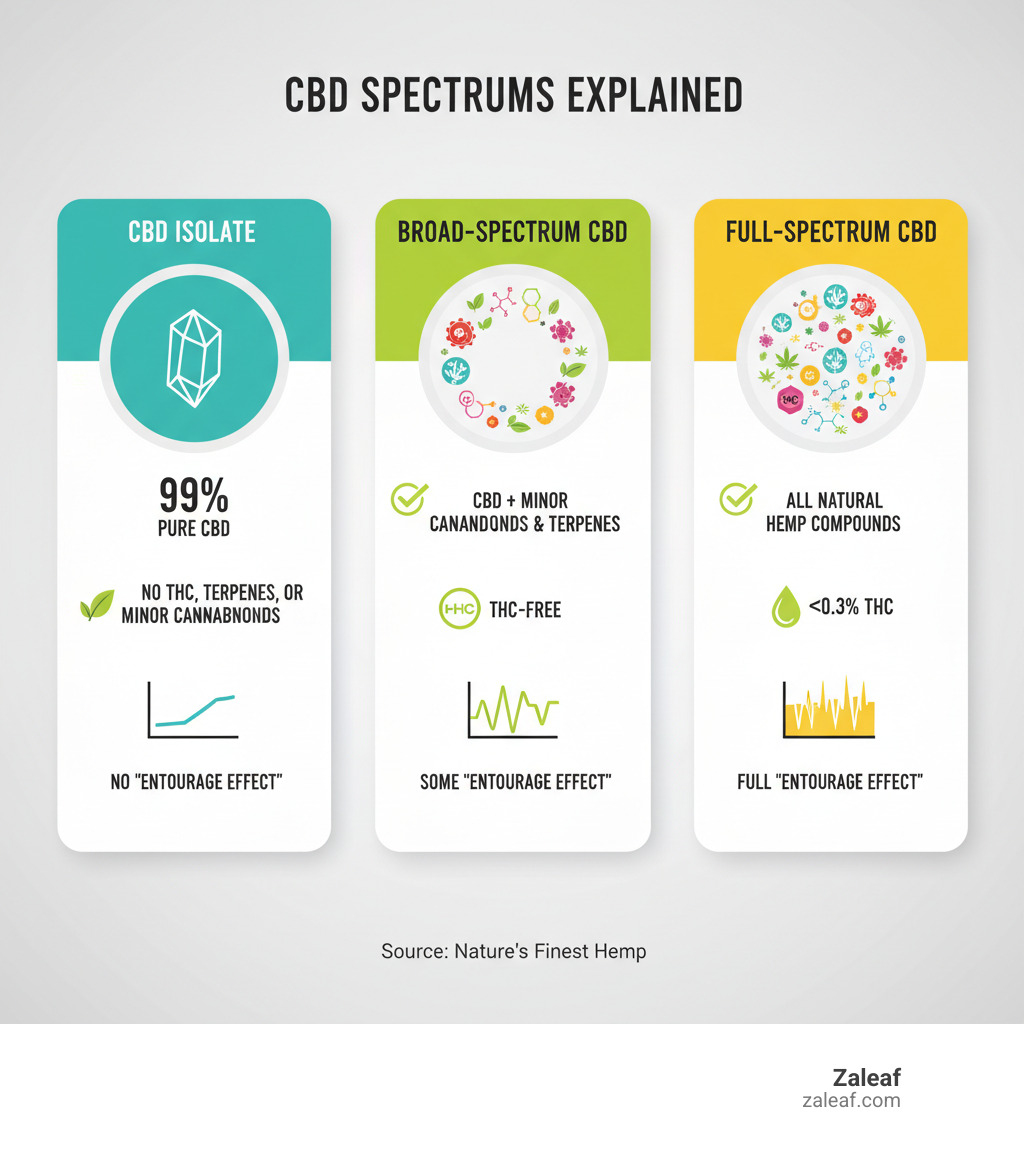
CBD isolate is the purest form of CBD you can get – 99% pure cannabidiol with everything else stripped away. All other plant compounds, including terpenes, flavonoids, and other cannabinoids (yes, even trace amounts of THC), are completely removed. If you want to experience CBD in its singular form and are concerned about even the tiniest amount of THC showing up, isolate is your answer. The trade-off? You miss out on what's known as the "entourage effect."
Broad-spectrum CBD is where things get interesting. This extract contains most of the hemp plant's natural compounds – other cannabinoids like CBG, CBN, and CBC, plus those beneficial terpenes – but with one crucial difference: the THC has been completely removed or exists at non-detectable levels. You get a more comprehensive experience than isolate, with some of that valuable "entourage effect," but without any worry about THC. Our broad-spectrum certified CBD vape pens at Zaleaf are tested for THC with a limit of detection of 0.040 and consistently pass, ensuring truly non-detectable levels.
Full-spectrum CBD is the whole plant experience. This is the least processed type of extract, containing all the naturally occurring compounds found in the hemp plant working together in harmony. You get CBD, minor cannabinoids, terpenes, flavonoids, and yes, trace amounts of THC (always less than 0.3%, as required by the 2018 Farm Bill). The presence of all these compounds creating the "entourage effect" means the combined impact is greater than the sum of its individual parts. Many users swear by full-spectrum products for providing a deeper, more holistic CBD experience.
Your choice between these spectrums really depends on your individual needs and preferences, especially your comfort level with THC. If you're curious about how different cannabinoids interact and complement each other, our guide on CBD vs Delta-8: Exploring the best of both worlds offers some fascinating insights.
Disposable Vapes vs. Refillable Systems
Choosing between a disposable certified CBD vape and a refillable system is a bit like deciding between paper plates and real dishes. Both get the job done, but they serve different lifestyles and priorities.
Disposable vapes are the definition of convenience. You open the package, start vaping, and when it's done, you toss it. There's no charging, no refilling, no maintenance whatsoever. They're perfect for beginners who want to try CBD vaping without investing in equipment, or for anyone who values simplicity and portability above all else. Slip one in your pocket and you're good to go. The downside? They're more expensive per puff over time, and they're not exactly environmentally friendly since you're throwing away the entire device, battery and all, when it's empty.
Refillable systems require a bit more commitment upfront. You'll need to purchase a battery (often a standard 510-thread battery that works with most cartridges) and either buy pre-filled cartridges or bottles of CBD e-liquid to refill your tank. Yes, there's some maintenance involved – keeping your device charged, occasionally cleaning it, and learning how to refill it properly. But here's the payoff: refillable systems are significantly more cost-effective in the long run. You're only replacing the liquid, not the entire device. They also offer more variety in flavors and CBD concentrations, letting you customize your experience. And if you care about reducing waste, refillables are the clear winner for environmental impact.
So which should you choose? If you're new to CBD vaping, traveling frequently, or just want something hassle-free for occasional use, disposables make perfect sense. If you're planning to vape regularly, want to save money over time, and prefer having more control over your experience, a refillable system is worth the small learning curve. For a deeper look at disposable options, check out our guide to the best CBD disposable vape pens, or explore our recommendations in Vape your way: Best CBD pens to buy online.
At Zaleaf, we offer both options because we understand that everyone's needs are different. What matters most is that whether you choose disposable or refillable, you're getting a certified CBD vape that's been rigorously tested and made with clean, safe ingredients.