

Ordering Vapes Online Without Breaking Federal Shipping Regulations
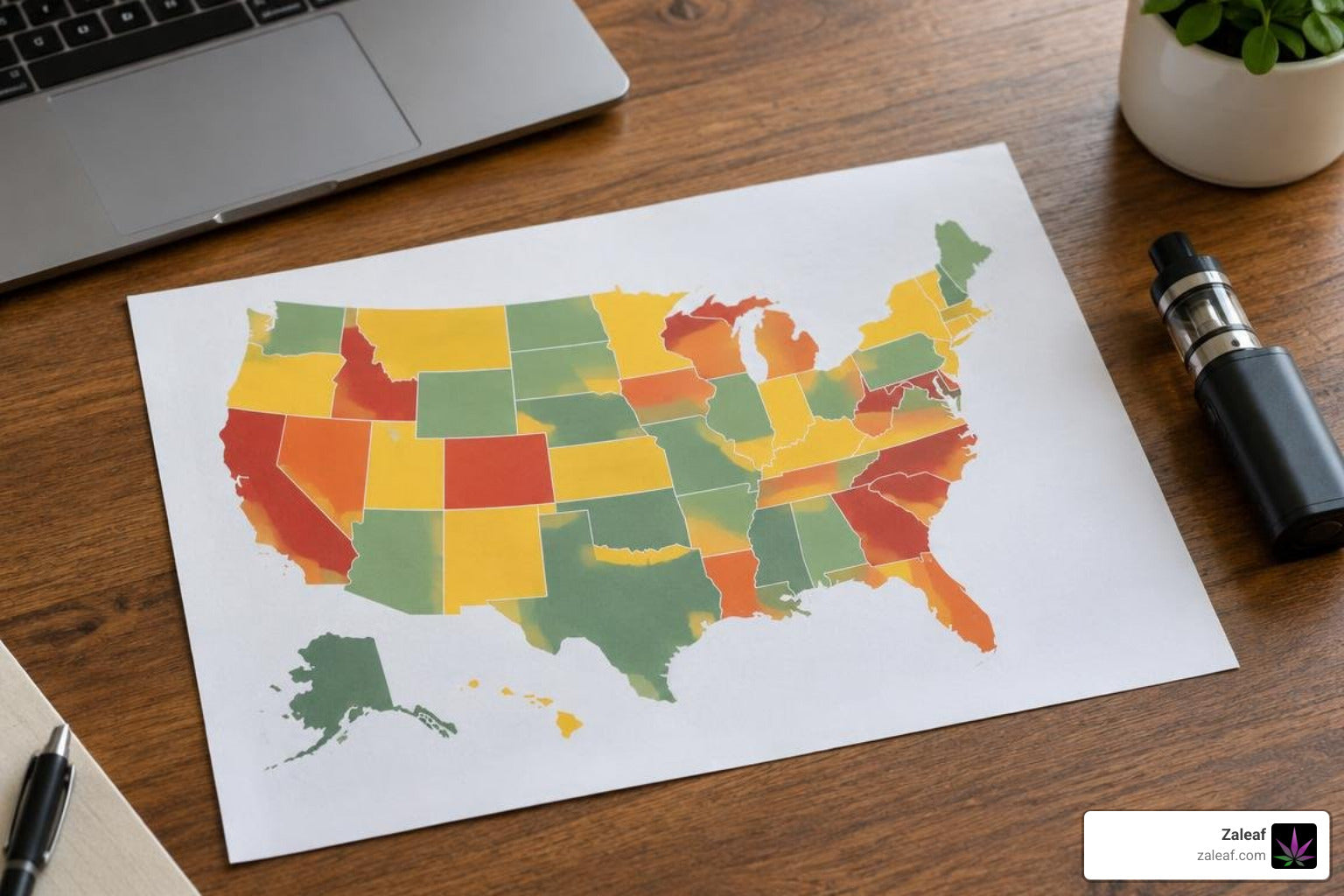
State Restrictions, Flavor Bans, and Product Directories
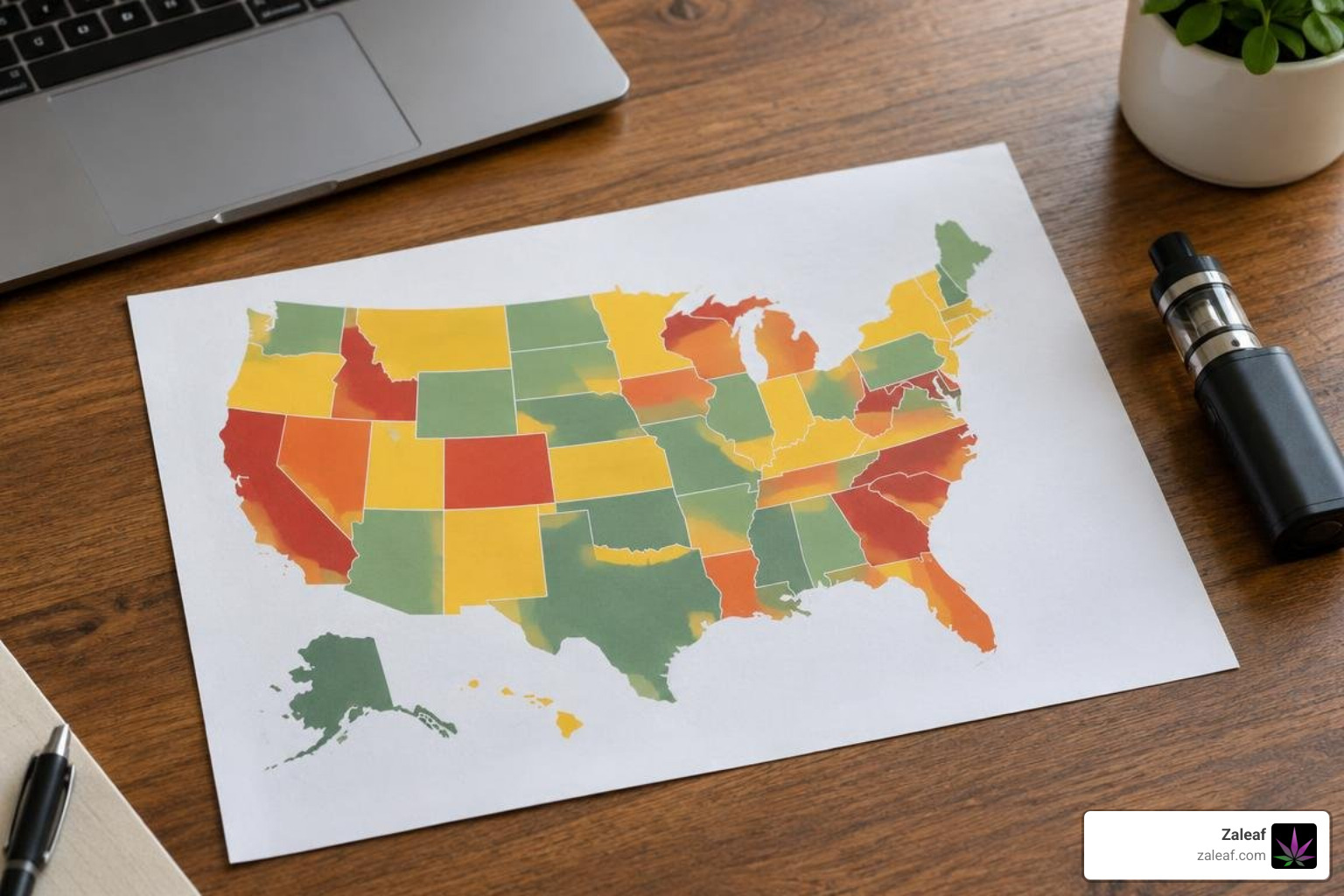
Yes, adult consumers can still order vapes online legally in 2026, but only through compliant retailers that follow federal shipping, age verification, and state tax rules. Federal compliance governs every stage of an online vapor sale. Under the Deeming Rule, the U.S. Food and Drug Administration (FDA) regulates Electronic Nicotine Delivery Systems (ENDS) as tobacco products. Manufacturers must submit Premarket Tobacco Product Applications (PMTA) demonstrating that marketing their devices is appropriate for the protection of public health.
As of March 2026, only 41 e-cigarette products from a small handful of manufacturers have received formal FDA marketing authorization, primarily restricted to specific tobacco-flavored closed systems. When consumers explore whether is it illegal to order vapes online, the answer hinges on how sellers navigate these interstate commerce laws. Federal law permits delivery sales between businesses and adult consumers, provided the seller follows federal registration rules, collects applicable excise taxes, and partners exclusively with compliant delivery carriers.
Can You Still Order Vapes Online Under Current Federal Shipping Bans?
The physical logistics of buying vapor products changed dramatically when the United States Postal Service (USPS) enacted its final rule banning the mailing of ENDS products to residential addresses. Shortly thereafter, major private carriers including UPS, FedEx, and DHL followed suit by restricting consumer deliveries of nicotine vapor devices.
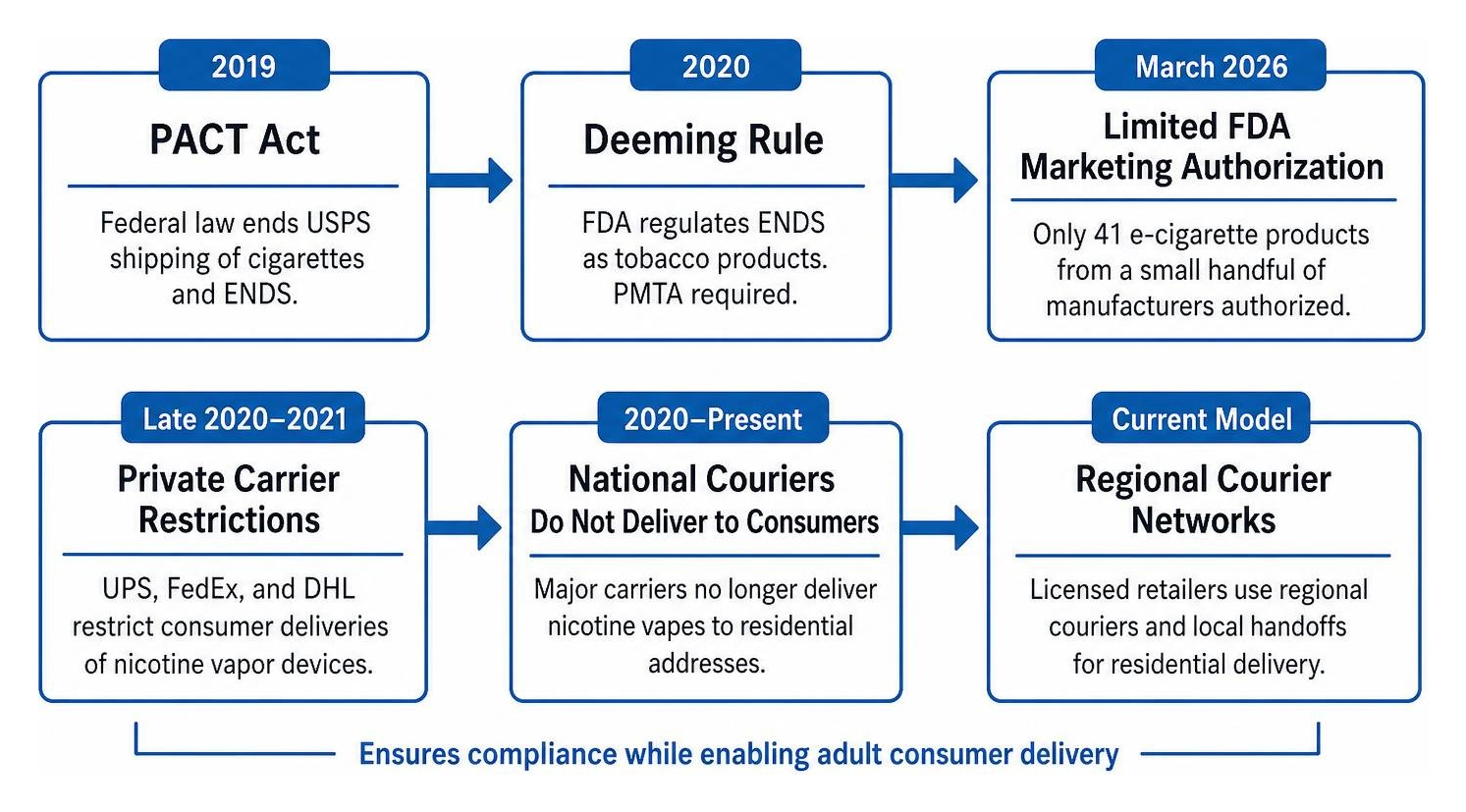
Because primary national couriers no longer deliver consumer nicotine vapes, licensed online retailers rely on regional courier networks. These independent logistics providers transport packages across multi-state shipping hubs before handing them off to localized couriers for residential delivery.
This specialized network introduces noticeable changes to the checkout experience:
- Transit Delays: Standard 2-day delivery is largely unavailable. Regional carrier handoffs typically require 5 to 10 business days depending on customer location.
- Carrier Surcharges: Retailers must absorb or pass along adult signature delivery fees, which often add $7 to $9 per order.
- Mandatory Signature: Couriers cannot leave parcels unattended on doorsteps. An individual aged 21 or older must present a valid government photo ID upon delivery.
Understanding these protocols prevents surprise fees and missed packages. When reviewing order details, understanding age verification and ID policies ensures you have the necessary documentation ready when your parcel arrives.
Federal PACT Act Rules and Retailer Responsibilities
The Prevent All Cigarette Trafficking (PACT) Act serves as the primary federal mechanism governing remote tobacco and vapor sales. Originally passed to curb tax avoidance on cigarettes, the law was amended to include all electronic nicotine delivery systems, e-liquids, and related components.
Under the PACT Act, delivery sellers must satisfy rigorous compliance mandates:
- ATF Registration: Register with the Bureau of Alcohol, Tobacco, Firearms and Explosives (ATF) as a remote delivery seller.
- State Tax Filings: File monthly shipping manifests with state tobacco tax administrators detailing customer names, addresses, quantities, and brands shipped.
- Excise Tax Collection: Collect and remit all destination-state excise taxes at checkout. For instance, Maine's vapor tax increased from 43% to 75% of wholesale price, effective January 5, 2026, which compliant retailers must calculate during payment processing.
- Third-Party Age Verification: Verify customer names, birthdates, and residential addresses against commercial identity databases prior to processing payments.
Failure to follow these protocols carries severe legal consequences. Delivery sellers violating PACT Act mandates face civil penalties of up to $5,000 for a first violation and $10,000 for each additional infraction, alongside potential federal criminal charges.
| Retailer Feature | Fully Compliant Retailer | Illicit / Unregulated Vendor |
|---|---|---|
| Age Verification | Database validation at checkout + Photo ID upload | Simple 18+/21+ checkbox or none |
| Delivery Method | Regional couriers requiring 21+ adult signature | Standard non-compliant commercial post |
| Tax Collection | Calculates exact destination-state excise taxes | No local or state tobacco taxes collected |
| Payment Security | Encrypted high-risk credit merchant gateway | Cryptocurrency, peer-to-peer apps, or wire transfer only |
| Product Authorization | Complies with PMTA and state product directories | Stocks unauthorized, counterfeit, or illicit imports |
State legislation adds an additional layer of complexity to online vape fulfillment. While federal law sets baseline rules for shipping and age checks, states hold broad authority to restrict flavors, ban specific device categories, or block remote direct-to-consumer shipments entirely.
Several states have enacted strict state product directories (including Florida, North Carolina, and Wisconsin). In directory states, manufacturers must certify that their items hold valid FDA PMTA authorization or remain under active, non-denied review. State regulators compile an official registry of authorized stock keeping units (SKUs). Retailers cannot legally ship any vapor product to addresses within those states unless the product appears on the active registry.
Similarly, California enforces Senate Bill 793, which prohibits the sale of most flavored e-liquids, disposables, and nicotine pods with characterizing aromas other than tobacco. Navigating these regional distinctions requires checking current local laws before purchasing, just as adult shoppers prioritize finding a safe legal vape that complies with applicable standards.
How State Laws Impact If You Can Still Order Vapes Online
State regulations dictate product availability at the checkout stage. If your billing or shipping address sits within a restricted jurisdiction, compliant software will automatically restrict prohibited items from your shopping cart.
Key state frameworks include:
- Characterizing Flavor Bans: States such as California, Massachusetts, New York, New Jersey, and Rhode Island prohibit the sale of flavored vapor products. In these jurisdictions, remote sellers may only deliver tobacco-flavored or completely unflavored e-liquids and matching closed pods.
- Outright Delivery Bans: Certain states require all tobacco and nicotine purchases to occur in face-to-face retail environments, effectively prohibiting direct residential shipping for ENDS hardware and consumables.
- Directory Limitations: In states like Wisconsin or North Carolina, thousands of popular flavored disposable lines are excluded from official state directories, preventing legal distribution.
These state-level measures were introduced partly to reduce youth access. Over 1.6 million middle and high school students reported using e-cigarettes in the 2024 National Youth Tobacco Survey. Federal and state health agencies regularly study how minors bypass digital protections, as highlighted in this study on underage online vape sales, resulting in steadily tightening verification requirements across all state jurisdictions.
Penalties and Risks of Buying from Unregulated or Overseas Sellers
Frustrated by shipping delays or flavor restrictions, some consumers look to overseas e-commerce stores or unregulated storefronts that claim to bypass domestic laws. Sourcing vapor hardware from unauthorized sellers carries substantial financial and health risks.
Federal law enforcement actively targets illicit vape imports. In September 2025, a joint operation between the Department of Health and Human Services (HHS) and U.S. Customs and Border Protection (CBP) seized 4.7 million units of unauthorized e-cigarettes valued at $86.5 million. When customs officials intercept illicit packages at international ports of entry, the items are seized and destroyed.
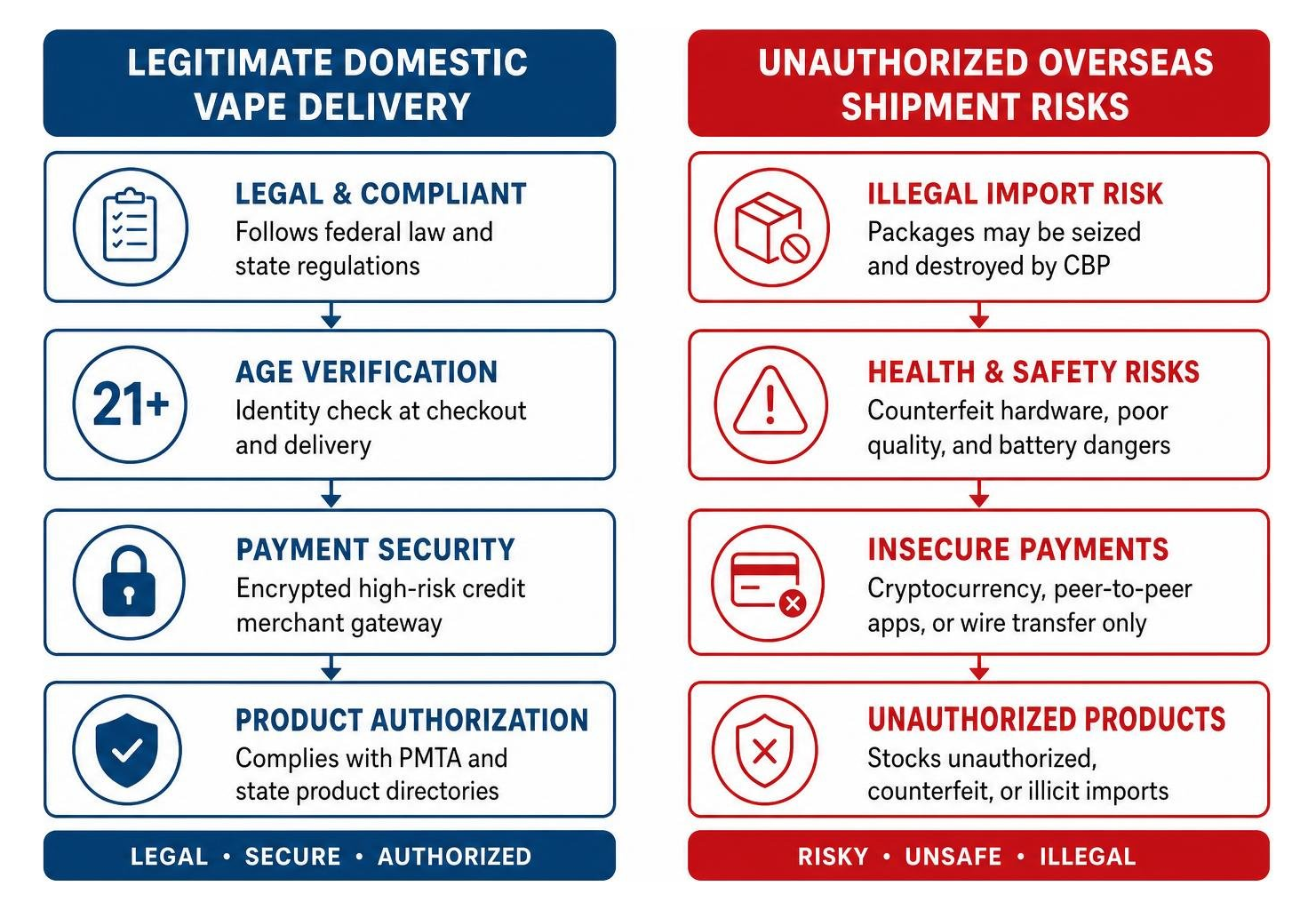
For the buyer, ordering from unregulated platforms often results in:
- Financial Forfeiture: Packages seized by CBP or state tax agents are confiscated without consumer compensation, and illicit sellers rarely offer refunds.
- Counterfeit Hardware: Unregulated devices often lack basic quality control, creating risks of leaking e-liquid, inconsistent heating elements, and defective lithium-ion batteries.
- Identity Exposure: Websites operating outside the law frequently use unencrypted or dubious payment processors, putting your financial information at risk.
For shoppers looking for federally legal hemp and wellness alternatives, our discreet private deliveries guide highlights how compliant domestic brands protect consumer privacy while following all packaging and mailing standards.
How to Safely and Legally Purchase Vapes Online
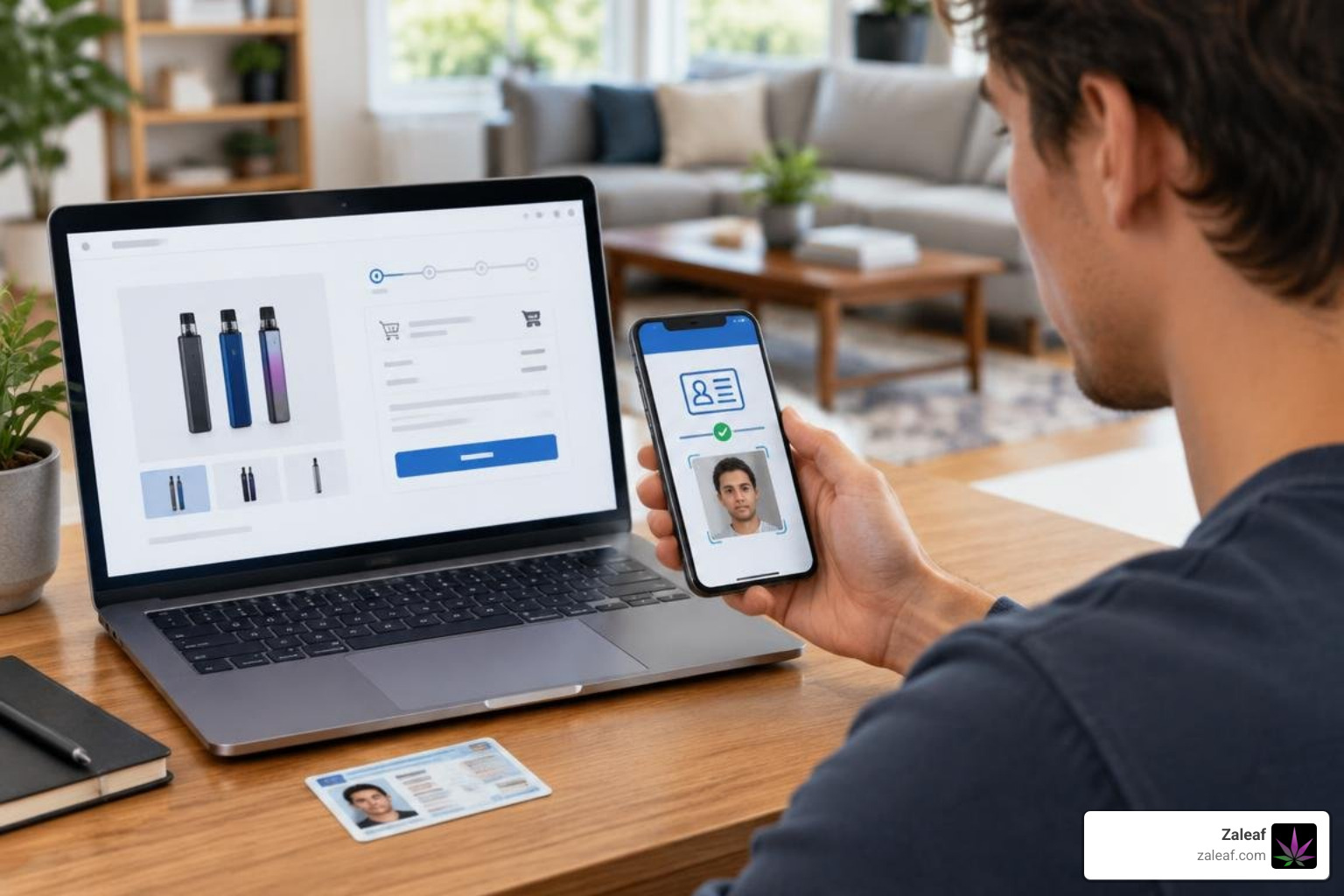
Ordering vapor products safely requires knowing how legitimate e-commerce stores operate. Compliant platforms use verified merchant processors and clear terms of service to keep every transaction within federal guidelines.
Legitimate businesses invest heavily in automated age verification technology. When you enter your billing details, the site queries national public records (such as voter registries and credit bureau databases) to verify your name, address, and date of birth. If the automated system cannot confirm your details instantly, you will be prompted to upload a clear photograph of your government-issued ID.
Identifying Legitimate Online Vape Retailers
Before submitting payment details, look for clear trust indicators across the storefront:
- Real-Time Age Verification: The checkout workflow includes an integrated identity check rather than a simple self-certification prompt.
- Physical Business Presence: A verifiable street address, customer service telephone number, and operating hours are listed in the footer or contact page.
- Explicit Shipping Terms: The site clearly outlines regional carrier transit times, adult signature requirements, and state-specific shipping restrictions.
- Encrypted Checkout: Secure socket layer (HTTPS) encryption protects account registration and payment forms.
- Transparent Lab Testing: High-quality vendors publish third-party Certificates of Analysis (COAs) validating formulation purity and hardware integrity.
Step-by-Step Guide to Receiving Compliant Deliveries
Follow these practical steps to ensure your shipment arrives without disruption:
- Check Local Statutes: Review your state and municipal laws to confirm your desired hardware, e-liquid capacity, and flavor profile are legal for residential import.
- Prepare Identification: Ensure your current residential address matches the government ID you will use for online age verification.
- Select Approved Payment: Use a major credit or debit card. Compliant merchants use high-risk merchant accounts rather than peer-to-peer payment platforms.
- Monitor Tracking Updates: Regional carriers provide tracking updates as packages move through regional consolidation hubs.
- Arrange for Adult Receipt: Ensure an adult aged 21 or older is present at the delivery address with a valid photo ID to provide the required physical signature. If you are away, carriers will leave a notice with instructions for redelivery or pickup at a local commercial depot.
Frequently Asked Questions About Ordering Vapes Online
Can you order vapes online if you are under 21?
No. Federal law establishes a nationwide minimum age of 21 for purchasing all tobacco and vapor products. Compliant online stores use identity validation tools that prevent underage individuals from placing orders, and regional couriers are legally prohibited from handing over packages without verifying a 21+ government photo ID.
Why does shipping cost more for online vape orders?
Online vape shipping costs more than standard retail shipping due to three main factors:
- Major couriers like USPS do not service residential nicotine shipments, requiring retailers to use private regional carrier networks.
- Federal law mandates an adult signature service on delivery, which adds a carrier fee to every package.
- Retailers must collect and remit state and municipal excise taxes based on the delivery destination.
What happens if an online vape order gets seized?
If a package containing unauthorized or non-compliant vapor products is intercepted by customs officials or law enforcement, the shipment is confiscated and destroyed. Buyers lose the money paid for the items, while the delivery seller faces regulatory fines and potential PACT Act enforcement actions.
Conclusion
Ordering vapes online remains entirely legal for adult consumers across most of the United States, provided transactions follow federal PACT Act requirements, state product directories, and regional carrier rules. While shipping fees are higher and delivery takes longer than standard parcel post, these processes ensure that authentic products reach adult customers safely.
For consumers interested in federally legal cannabinoid products, we offer an accessible, compliant alternative. At Zaleaf, we provide 100% legal cannabis and mood-enhancing cannabinoid formulations designed to deliver reliable, functional experiences. Every batch undergoes comprehensive third-party lab testing for purity and potency, shipped directly to your door in fast, discreet packaging without complicated signature roadblocks.
To learn more about how adult verification standards apply across different online platforms, read our guide on ordering vapes online without ID requirements.