

What is the Best Temperature for Vaping?
Why the Best Temperature for Vaping Changes Everything About Your Experience

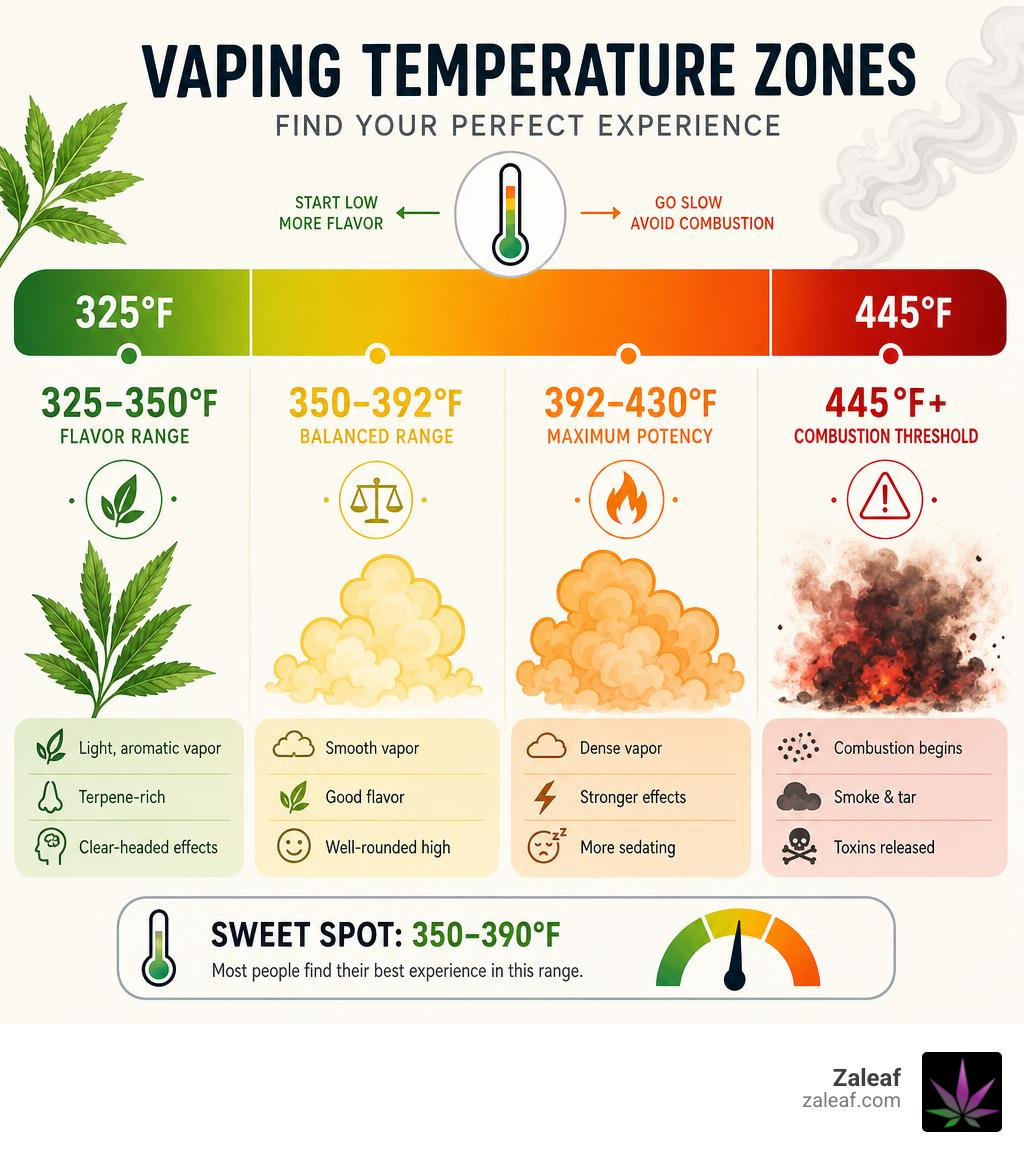
The best temperature for vaping sits between 180–200°C (356–392°F) for most dry herb sessions — but the right setting depends on what you want to get out of your vape.
Here's a quick reference to match temperature to your goal:
| Goal | Temperature Range | What You Get |
|---|---|---|
| Flavor & microdosing | 163–177°C (325–350°F) | Light, aromatic vapor; terpene-rich; clear-headed |
| Balanced effects | 177–200°C (350–392°F) | Smooth vapor; good flavor; well-rounded high |
| Maximum potency | 200–221°C (392–430°F) | Dense vapor; stronger sedation; less flavor |
| Avoid at all costs | 229°C+ (445°F+) | Combustion begins; smoke, tar, and toxins |
Most people find their sweet spot somewhere in the 350–390°F range. Start there if you're unsure.
Temperature is the single variable that controls everything about a vaping session — which cannabinoids activate, which terpenes survive, how smooth the vapor feels, and how strong the effects hit. Set it too low and you'll barely feel anything. Push it too high and you're no longer vaping — you're combusting.
Whether you're winding down after a long day or looking for focused, daytime relief, dialing in the right heat setting makes the difference between a mediocre experience and a genuinely great one.
I'm Max Shemesh, CEO of Zaleaf, and through years of working with hemp and cannabinoid products, I've seen how much temperature precision matters for getting the most out of every session — it's one of the most common questions we get from customers exploring the best temperature for vaping. In this guide, I'll walk you through everything you need to know to get it right.
Why Temperature is the Single Most Important Variable in Vaping
When we smoke a joint or use a pipe, we are using a sledgehammer of heat. The tip of a burning joint can reach temperatures of up to 900°C (1,652°F). This level of heat is incredibly destructive. It instantly incinerates a vast percentage of the cannabinoids and terpenes before they ever reach your lungs. You are left inhaling smoke, ash, tar, carbon monoxide, and other unwanted byproducts.
Vaping, by contrast, is like using a sniper rifle. Instead of burning the plant material, a vaporizer heats your dry herb or concentrate just enough to transition the active, therapeutic compounds from a solid or liquid state into an inhalable vapor. This process relies on reaching the specific boiling points of various compounds without crossing the dreaded combustion threshold.
The magic happens right around 220°F (104°C), where the resin-producing trichomes on the flower begin to melt and release their active ingredients. As we adjust the temperature upward, we systematically unlock different layers of the plant's chemical profile.
However, if we push the temperature too far—specifically past 229°C (445°F)—we trigger thermal degradation and combustion. At this point, the plant material catches fire, introducing harmful toxins like benzene (a known carcinogen with a boiling point range starting around 205°C under certain conditions) and heavy tars into your vapor.
By understanding how to manipulate your heat settings, you have direct control over your experience. You can choose to volatilize delicate terpenes for pure flavor, or target heavier cannabinoids for deep physical relief. For a deeper dive into how heat interacts with your device's heating chamber, check out the Vaporizer Temperature Guide: What Settings Actually Work.
Finding the Best Temperature for Vaping Dry Herb
Finding the best temperature for vaping dry herb is a personal journey, but it is heavily guided by science. The dry flower contains a complex matrix of moisture, plant fiber, cannabinoids, and terpenes. How your vaporizer extracts these elements depends on your temperature setting, grind consistency, and the device's heating style.
To get the most out of your dry herb, we recommend a medium-fine grind (resembling coarse sea salt) and ensuring your flower is properly cured (ideally between 55% and 62% relative humidity). Wet, under-cured bud will require too much thermal energy just to evaporate the excess water, resulting in thin, unsatisfying vapor.
To help you navigate your options, we have broken down the three primary temperature zones below:
| Temperature Zone | Fahrenheit Range | Celsius Range | Primary Compounds Released | Vapor Characteristics | Best Suited For |
|---|---|---|---|---|---|
| Low Zone | 325°F – 350°F | 163°C – 177°C | Pinene, Limonene, Caryophyllene, THC | Light, thin, incredibly flavorful, cool on the throat | Daytime focus, microdosing, flavor chasing, avoiding coughing |
| Medium Zone | 350°F – 400°F | 177°C – 204°C | Myrcene, Linalool, CBD, CBN | Balanced density, rich flavor, smooth throat hit | All-day vaping, moderate relaxation, transitioning smokers |
| High Zone | 400°F – 430°F | 204°C – 221°C | THCV, Humulene, CBC, trace Benzene (near maximums) | Thick, dense, cloud-heavy, warm and dry | Evening use, heavy sedation, pain relief, maximum extraction |
Each zone offers a completely distinct physical and mental experience. Let's look closer at how these ranges operate and how to choose the right one for your goals. For more details on customizing these ranges, explore the Ideal Temperatures For Vaporising Cannabis.
Low Temperature Zone: Best Temperature for Vaping for Flavor and Clarity
Vaping in the low range (325°F to 350°F / 163°C to 177°C) is all about terpene preservation. Terpenes are the volatile aromatic compounds that give cannabis its distinctive scent and modulate the effects of cannabinoids through the entourage effect. Because terpenes have lower boiling points than many cannabinoids, they are the first to volatilize.

In this zone, you will experience:
- Volatile Terpene Extraction: Highly delicate terpenes like alpha-pinene (which promotes mental clarity and focus) and limonene (known for its uplifting, citrusy, anti-anxiety properties) are vaporized perfectly without being scorched.
- Mild, Functional Effects: Since you are only vaporizing a portion of the available THC and leaving heavier, more sedative cannabinoids behind, the high is gentle, clear-headed, and energetic.
- Daytime Productivity: This is the ultimate zone for microdosing. You can enjoy the therapeutic benefits of your flower without experiencing brain fog or physical lethargy.
- Cooler Throat Hits: Because the vapor is kept at a lower temperature, it does not irritate your airways or dry out your throat, making it perfect for beginners or those prone to coughing.
If you don't see massive, billowing clouds in this range, don't panic! At lower temperatures, the vapor remains largely in a gaseous phase, making it less visible upon exhale. Rest assured, you are still inhaling active compounds.
Medium Temperature Zone: The Sweet Spot for Balanced Effects
For the vast majority of users, the medium temperature zone (350°F to 400°F / 177°C to 204°C) represents the absolute sweet spot. It offers a beautiful compromise, extracting plenty of flavorful terpenes while activating a much higher concentration of cannabinoids.
In this zone, we see:
- Activation of Myrcene and Linalool: Myrcene (the most common terpene in cannabis, known for its herbal aroma and muscle-relaxing properties) boils around 166–168°C (330–334°F). Linalool (a floral terpene that promotes deep stress relief and calming mental effects) activates around 198°C (388°F).
- Balanced High: By unlocking these terpenes alongside a more robust dose of THC and CBD, you experience a full-spectrum, well-rounded high that is both physically relaxing and mentally engaging.
- Dense, Satisfying Vapor: The vapor becomes visibly thicker and warmer, providing a satisfying throat hit that former smokers often crave, without the harshness of combustion.
To maintain a consistent temperature in this zone, having a reliable device is key. If you are using cartridge-based systems or looking to understand how power levels dictate your heat, check out our guide on how to Power Up Your Vape Finding The Right Variable Voltage Battery.
High Temperature Zone: Best Temperature for Vaping for Maximum Potency and Sedation
When you need heavy-hitting effects, deep physical relaxation, or help falling asleep, it's time to bump your device up to the high temperature zone (400°F to 430°F / 204°C to 221°C).
Here is what happens when you turn up the heat:
- Full Cannabinoid Extraction: Higher temperatures are required to fully extract heavier compounds like CBN (cannabinol, which is highly sedative and excellent for sleep support) and THCV (tetrahydrocannabivarin, which activates at 220°C/428°F).
- The "Couch Lock" Effect: The combination of fully extracted THC, CBN, and heavier terpenes creates a deeply relaxing, sedative body high.
- Maximum Efficiency: This range extracts every last drop of active compound from your plant material, leaving your bud looking dark brown (often referred to as Already Been Vaped, or ABV).
The trade-off here is flavor and comfort. At these temperatures, the delicate, delicious terpenes are quickly depleted in the first puff or two, leaving behind a toasted, popcorn-like flavor. The vapor is also much hotter and drier, which can cause coughing or dry mouth.
Pro-Tip: To make high-temperature sessions smoother, consider vaping through a water filtration attachment (like a bubbler), which can drop the vapor temperature by 20°C to 30°C. Also, to ensure your device is fully primed to vaporize these heavy compounds right from your first draw, read up on preheating in our article, Do You Really Need To Preheat Your Vape Pen The Truth About This Feature.
The Science of Boiling Points: Cannabinoids, Terpenes, and Concentrates
To truly master the best temperature for vaping, we have to look at the specific boiling points of the molecules we are trying to extract. Every cannabinoid and terpene has a unique temperature at which it transitions into vapor.
Let's look at the scientific boiling points of the key players in the cannabis plant:
- THC: ~157°C (315°F) — Delivers the primary psychoactive high and pain relief.
- CBD: 160–180°C (320–356°F) — Non-psychoactive, highly anti-inflammatory, and calming.
- CBN: 185°C (365°F) — Heavily sedative, formed as THC degrades over time.
- CBC: 220°C (428°F) — Anti-inflammatory and works synergistically with other cannabinoids.
- THCV: 220°C (428°F) — Energetic, appetite-suppressing, and highly therapeutic.
- Beta-Caryophyllene: 119°C (246°F) — Peppery aroma, acts on CB2 receptors to reduce inflammation.
- Alpha-Pinene: 156°C (312°F) — Pine aroma, improves focus and acts as a bronchodilator.
- Myrcene: 166–168°C (330–334°F) — Musky aroma, enhances cannabinoid absorption.
- Limonene: 176°C (349°F) — Citrus aroma, highly uplifting and stress-relieving.
- Linalool: 198°C (388°F) — Lavender aroma, deeply relaxing and sleep-promoting.
To visualize how these boiling points align with standard device settings, check out the Vaporizer Temperature Chart: THC 157°C, CBD 180°C (2026).
How Concentrate and E-Juice Vaping Temperatures Differ
If you are vaping concentrates (such as live resin, wax, or shatter) or e-juices, your temperature settings will look very different from dry herb settings. Concentrates are completely devoid of plant material, meaning they consist purely of cannabinoids and terpenes. Because they are much denser and thicker, they require higher temperatures to melt and vaporize efficiently.
-
Live Resin and Dabs: The ideal range for live resin and other concentrates is typically 500°F to 600°F (260°C to 315°C).
- Low-Temp Dabs (400°F – 450°F) preserve the incredible terpene profiles of live resin, offering unmatched flavor.
- Mid-Range Dabs (500°F – 550°F) provide the perfect balance of massive clouds and rich flavor.
- Avoid going above 600°F, as high-temperature dabbing can burn off your terpenes instantly, produce harsh vapor, and potentially release unwanted thermal degradation byproducts.
-
E-Juices: Standard nicotine or flavored e-liquids rely on a base of Propylene Glycol (PG) and Vegetable Glycerin (VG). The optimal temperature range for e-juice is 200°C to 250°C (392°F to 480°F).
- High-PG liquids (which carry flavor better) perform beautifully at lower ranges (200°C to 220°C).
- High-VG liquids (which produce thick clouds) require more heat (220°C to 250°C).
- For a detailed walkthrough on setting up your liquid vape, read the Best Temperature to Vape E-Juice: Your Simple Guide.
If your device does not have a digital screen showing Fahrenheit or Celsius, you will likely be adjusting your settings using wattage or voltage. For a comprehensive look at how wattage affects vapor density and flavor, check out the guide on What Wattage Should I Vape At? (9 Things to Consider).
Frequently Asked Questions about Vaping Temperatures
At what temperature does cannabis combustion begin?
Cannabis combustion begins around 445°F (229°C). Once your herb reaches this temperature, it stops vaporizing and starts burning. This introduces smoke, tar, carbon monoxide, and other harmful toxins into your lungs. To keep your experience clean, healthy, and flavorful, we always recommend keeping your dry herb vaporizer set to 430°F (221°C) or below.
Does vaping at a lower temperature waste your flower?
Not at all! Vaping at a lower temperature simply extracts the more volatile compounds (like pinene, limonene, and THC) while leaving the heavier compounds intact.
In fact, low-temperature vaping is incredibly efficient because you can use a technique called temperature stepping. You can start your session at a low temperature (say, 340°F) to enjoy the pure, delicious flavors of your terpenes. Once the vapor thins out, bump the temperature up to 380°F to extract the remaining THC and CBD. Finally, finish the session at 410°F to extract the sedative CBN.
Additionally, your leftover light-brown bud—known as Already Been Vaped (ABV) material—is already decarboxylated. Instead of throwing it away, you can reuse it to make potent cannabis-infused butter, coconut oil, or tinctures!
How do battery voltage settings relate to temperature?
If you are using a 510-thread vape pen cartridge, you won't see a temperature control dial. Instead, you will adjust your settings using voltage.
Voltage directly dictates how much electrical current is sent to the cartridge's heating coil. Because cartridges have different coil resistances, higher voltage equals higher temperatures.
- 2.5V – 3.0V: The low-temperature equivalent. Ideal for preserving the delicate terpenes in live resin cartridges, providing smooth, highly flavorful hits.
- 3.0V – 3.5V: The medium-temperature equivalent. Great for standard distillates, offering a balanced throat hit and solid vapor production.
- 3.5V+: High-temperature range. Produces massive clouds but can easily scorch your oil, ruin the flavor, and degrade the cannabinoids.
To find the perfect power source that gives you complete control over your cartridge sessions, check out The Essential 510 Thread Battery Buyers Guide.
Conclusion
Finding the best temperature for vaping is all about tailoring your session to your personal goals. Whether you want to enjoy a flavorful, clear-headed daytime session at 330°F, find a balanced all-day groove at 375°F, or drift off to sleep with a heavy-hitting 410°F session, controlling your temperature gives you ultimate power over your cannabis experience.
At Zaleaf, we specialize in helping you elevate your routine. We offer 100% legal, high-quality cannabis products designed to enhance specific cannabinoid and terpene profiles for mood-specific effects. Every product we carry undergoes rigorous 3rd party testing to ensure safety, potency, and purity. Plus, we make getting your stash incredibly easy with fast shipping, discrete packaging, and absolutely no ID or medical card required.
Ready to take your vape game to the next level? Make sure your hardware is up to the task by reading our guide to Maximize your vaping experience with Zaleaf's battery guide. Stay lifted, stay precise, and enjoy the perfect session!